
Nature of Source
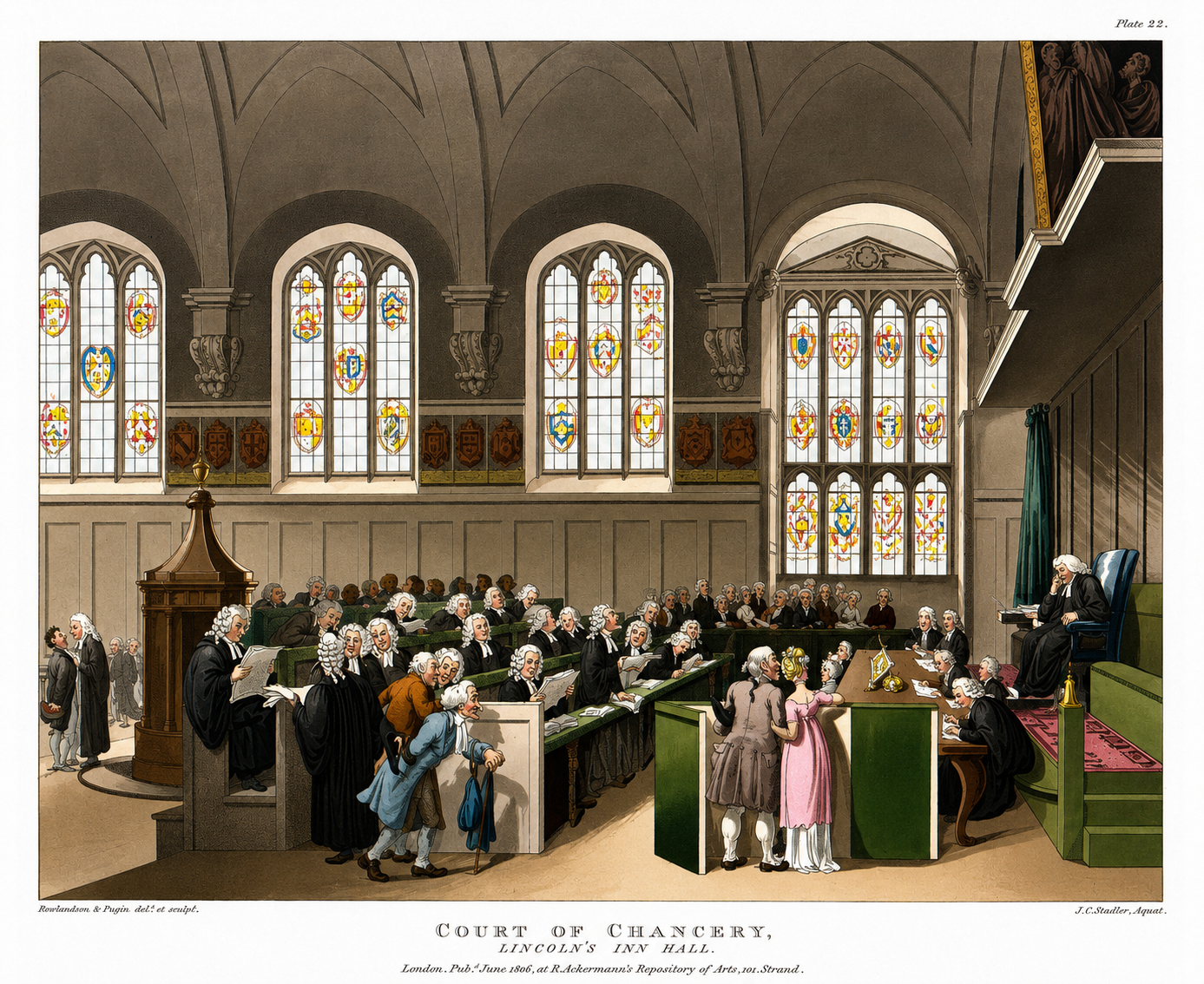
Court of Chancery, Lincoln’s Inn Hall, 1808
Introduction
Records from Equity courts such as the Chancery Court, Exchequer Court, Court of Requests (1483-1642) and Court of Star Chamber (1485-1641) offer a wealth of information, providing detailed insights into our ancestor’s lives, familial relationships, property ownership and social status. These courts handled civil disputes (suits) and competed for business with Common or Customary law courts. The Chancery court which was the prominent equity court also heard some common law cases and was active from circa 1199 until 1873. Equity courts were established to offer a more fair and flexible system of adjudication compared to the rigid application of medieval common law in Common or Customary law courts.
Types of Court Records and Process
Pleadings:
The pleadings opened a case, so these records are the starting point of research. The pleadings stage involved the plaintiff issuing a Bill of Complaint to the Lord Chancellor which sets out the case. The Bill lists the plaintiff’s name, occupation, rank or title, and address, along with the names of the defendants.
Answer
The defendant issued an Answer as a response and so followed a long-drawn out process of legal claims and counter-claims known as Replications and Rejoinders.
Depositions
These written testimonies or witness statements provide names, ages, addresses, and occupations of witnesses,
Affidavits
Sworn written statement of facts relevant to the case taken in addition to witness statements or depositions.
Decrees and Orders
These are decisions made by the court. They can show how disputes were settled or the legal status changed for individuals involved.
Reports
Summaries or findings from court officials or appointed referees.
Final Decrees and Outcomes
The conclusion and resolution of the case which may include details of land transfers or settlements.
Types of Cases
The courts dealt with a variety of family and legal disputes such as:
- Inheritance and wills
- Land ownership disputes
- Trusts, debts and mortgages
- Marriage settlements
- Apprenticeships agreement disputes
- Trade and business disputes
Court business was recorded in documents such as Close Rolls, Patent Rolls, and Charter Rolls.
Accessing and Navigating Records
Although the documents were written in English, they feature heavily abbreviated legal language making them difficult to interpret. Additionally, records were filed by document type rather than by individual case or suit, adding to their unwieldy nature.
The Bernau Index is a useful tool providing convenient access to Chancery court records. Compiled by Charles Bernau and the Society of Genealogists, it provides a card-based reference to individuals involved in Chancery cases, covering 1350 to 1800. The index includes the names of petitioners and defendants and the names of defendants and deponents and is particularly useful for locating depositions and pleadings. The Index is available at the Society of Genealogists which holds a microfilm collection of around four and a half million slips. A further 15,000 people giving evidence in Chancery court cases around the period 1714 to 1758 have been abstracted as part of the Society’s online digital collections made available to members. Microfilmed copies are available at the FamilySearch website and at affiliate libraries.
Additionally, court notices and orders from the Court of Chancery were published in the London Gazette, the official government publication. The Internet Archive hosts many digitised volumes of chancery proceedings.
Judicature Acts of 1873 and 1875
The Judicature Acts of 1873 and 1875 brought about significant far-reaching reforms of the English and Wales court system finally ending separate jurisdictions for common law and equity. The Acts consolidated the existing courts into a unified Supreme Court of Judicature bringing to an end the fragmented judicial process which had developed over time.
The Supreme Court was subdivided into two main divisions: the High Court of Justice, which handled original jurisdiction cases, and the Court of Appeal which dealt with appeals from lower courts. Eight historic courts including the Court of Chancery, the King’s/Queen’s Bench, the Court of Common Pleas, and the Court of Exchequer were all integrated into the newly formed High Court of Justice. By1880, The High Court consisted of three divisions:
- King’s Bench Division
- Chancery Division
- Family Division (formerly Probate, Divorce and Admiralty Division)
Also see
Assize Records
Court of Common Pleas
Court of Exchequer
Court of King’s/Queen’s Bench – Curia Regis
Court of Wards & Liveries
General Eyre
Petty Sessions
Quarter Session Records
Where Found
The National Archives
The archives holds extensive Chancery court records, including pleadings, decrees, orders, depositions, and action papers, spanning from the medieval period to the 20th century. Record series include:
- eries C. Records created, acquired, and inherited by Chancery. The records are predominantly those of Chancery as the central legal administration of the Crown, and of the court of Chancery as a court of equity and as a common law court.
- Series C 11, Pleadings 1714-1758. The Series is indexed by the first plaintiff and first defendant and is available at the Discovery First click on ‘Advanced search’. Enter the name being searched and in the box alongside ‘Search for or within references’ type ‘C 11’.
- Series C 65, Chancery: Parliament Rolls, 1289 to 1322.
- Series C 54, Chancery and Supreme Court of Judicature: Close Rolls.
- Series C 38, Chancery: Reports and Certificates, 1562-1875.
- Series C 103, Chancery: Master Blunt’s Exhibits, c1250-1859.
- Series J, Records of the Supreme Court of Judicature and related courts, c 1700-2002.
County Record Offices
Local archives may have copies, transcripts, or indexes related to Chancery cases especially that involved local individuals or properties and land.
Society of Genealogists
Bernau Index: The records consists of a microfilm collection of around four and a half million slips, dealing with equity courts including the Court of Chancery, the Court of Exchequer, the Court of Requests and the Star Chamber. The information was extracted mainly but not exclusively from series C 11. The index was compiled between 1914 and 1929 by Charles Allan Bernau (1878-1961) one of the founders of the Society of Genealogists. An entry in the index contains the names of petitioners and defendants and the names of defendants and deponents with a reference number to the original National Archives document.
British Record Society
Founded in 1889, the society specialises in publishing indexes, calendars and transcripts of British public records. The society is best known for indexes to pre-1858 wills and Hearth Tax returns. Other indexes include marriage licences, inquisitions post mortem, chancery proceedings and Coram Rege Rolls. Also check with local Record Societies for indexes and calendars of material held at a local level. Volumes can be found at local libraries, family history societies, the British Library, TNA library and the Society of Genealogists.
List and Index Society
The Society publishes records found in The National Archives, the British Museum, Scottish Record Office and others. The published records includes calendars of TNA’s holdings of Lay Subsidy Rolls, calendars of Patent Rolls, Tithe Award Records. Publications in yellow binders or covers relate to TNA records whilst those in red relate to records from other sources.
Harleian Society
The Harleian Society is a registered charity established in 1869 and incorporated in 1902. Its primary focus is on manuscripts relating to genealogy, family history and heraldry. It is particularly known for publishing detailed editions of the Heralds’ Visitations from the College of Arms of English and Welsh counties. The Society also publishes volumes of parish registers, primarily focusing on London parishes, Marriage Licenses, County Pedigrees, Grants of Arms and Chancery Proceedings.
Period Covered
1348 – 1873
Genealogical Value
- Names of plaintiffs and defendants, their age and status.
- Occupations and places of residence.
- Family relationships and pedigrees possibly spanning many generations.
- Birth, marriage and death dates.
- Land ownership and descriptions of landed property.
- Will date and details.
- Deponent’s name, age, address, occupation and other personal information.
Further References
- Bevan, Amanda. Tracing Your Ancestors in the National Archives: The National Archives, 2006
- Gerhold, D, Courts of Equity, A Guide to Chancery and other Legal Records, Pinhorn, 1994
- Guy, John. The Court of Star Chamber and its Records to the reign of Elizabeth I: HMSO, 1984
- Horwitz, Henry. Chancery Equity Records and Proceedings 1600-1800: Public Record Office, 1995
- Jacob, Giles. A New Law-Dictionary: Containing The Interpretation and Definition of Words and Terms Used in the Law: London, 1729 five editions (Some editions available to read online or download from Google Books and the Internet Archive)
- Jones, W. J. The Elizabethan Court of Chancery: Clarendon. Press, 1967
- Moore, Susan T. Family Feud: An Introduction to Chancery Proceedings: FFHS, 2003
- Moore, Susan. Tracing Your Ancestors Through the Equity Courts: A Guide for Family and Local Historians: Pen & Sword Family History, 2017
- Oates, Jonathan. Tracing Your Ancestors from 1066 to 1837: Pen and Sword Books, 2012
- Sharp, Hilary. How to Use the Bernau Index: Society of Genealogists, 1996
Websites
The National Archives Guide
How to look for records of chancery equity suits before 1558. This guide will help you to find, understand and interpret records of civil disputes heard by the court of Chancery from the late 14th century to 1558.
The National Archives Guide
How to look for records of chancery equity suits 1558-1875. This guide will help you to find and understand records of the Court of Chancery, which heard civil cases, referred to as equity suits, from 1558 until the dissolution of the court in 1875.
The National Archives Guide
How to look for records of appeal cases after 1875. Use this guide if you are looking for a civil or criminal appeal case in England or Wales after 1875.
The National Archives Guide
How to look for records of Court of Requests records 1485-1642. Use this guide for advice on how to find records of the Court of Requests spanning almost the entire life of the court, from 1485 to 1642.
The National Archives Guide
How to look for records of Court of Star Chamber records 1485-1642. This guide provides advice on how to find records created by and related to the Court of Star Chamber.
The National Archives Guide
How to look for records of Civil Court Cases: An Overview. This is a guide to searching for records at the National Archives of legal disputes, settled in court, between two parties over matters such as land, property rights, debt, inheritance and trusts. Such cases are known as civil cases, as opposed to criminal cases, and the legal process is known as civil litigation.
The Genealogist
Chancery Proceedings: the equity papers that put people, property and quarrels on the page. The court behind the paperwork.
Smithsonian Institution Archives
The Court of Chancery.
Luminarium Encyclopedia
The article provides an overview of the Star Chamber’s history, origin, jurisdiction, and eventual abolition.
Medieval Genealogy
Public records: Chancery and other equity suits. The site provides an overview of Chancery and equity in medieval England, detailing the historical context, records and their significance for genealogical research.
Courts and Tribunals Judiciary
Overview of the judiciary: An ancient system
FamilySearch Research Wiki
England Chancery Court Records.
Online Databases
The National Archives Catalogue
The former Equity Pleadings Database was separate database of 30,000 cases in the Court of Chancery from the period 1606-1722 which is now incorporated into the main catalogue. The series C 6 which consists of pleadings in equity suits initiated in the court of Chancery is included and can be searched by name or place. To search the cases, first click on ‘Advanced search’. Enter the name or place being searched and in the box alongside ‘Search for or within references’ type ‘C’.
Ancestry
British Chancery Records, 1386-1558. This database was compiled by Rosanna Hamilton and gathered primarily from the Lists of Early Chancery Proceedings, part of the PRO Lists and Indexes series.
Findmypast
Inheritance Disputes Index, 1574-1714This dataset is an index to over 26,000 lawsuits in the English Court of Chancery concerned with the inheritance of money or real estate. These cases typically involved several members of the same family. Search more than 77,000 names of those involved in over 26,000 law suits at the English Court of Chancery.
Findmypast
Charles I Court Of Chancery Index, 1625-1649. Discover your ancestor among almost 82,000 cases tried at the Court of Chancery in England during the reign of King Charles I. The index identifies the names of the plaintiff and defendant and gives the reference for the full documents held in The National Archives in London
Findmypast
Surrey Court Cases 1391-1835. Search an index created by Cliff Webb of Surrey court cases including cases from the Surrey Court of Star Chamber, 1485-1649; Surrey Exchequer Court, 1497-1835; Surrey Court of Requests, 1500-1624 and Surrey Court of Chancery, 1391-1758. Each transcript will give you the archival reference needed to request the documents from The National Archives.
The Genealogist
Court Record Collection. Search millions of historical names from rolls and calendars covering courts such as Court of Chancery, Court of Star Chamber, Court of Exchequer and the Court of Requests. The site features indexed entries and calendars of equity suits, allowing you to search records by forename, surname, date, and keyword.
Families in British India Society
Decrees of High Court of Chancery, 1748-1881. The listing is of decrees made by the High Court of Chancery in London as reported on the official London Gazette.
Anglo-American Legal Tradition
Explore digital images of documents from Medieval and Early Modern England from The National Archives, 1200 to 1650. Series covered include:
- Series CP 40 (Court of common pleas plea rolls)
- Series KB 27 (Court of king’s bench plea rolls)
- Series E 159 and E 368 (Memoranda rolls)
- Series E 13 (Exchequer plea rolls)
- Series C 33 (Chancery orders and decrees)
- Series JUST 1 (Records of the General Eyre and commissions of assize)
- Series CP 25 (Feet of Fines)
Wiki for the Anglo-American Legal Tradition
University of Houston. Search transcribed entries from Chancery suits and other legal cases from various periods, primarily from the 16th to the 19th centuries. Each page often includes digitised images.
CD Roms
GenFair
Browse tens of thousands of family history products from hundreds of suppliers. Products include: Index of Persons Named in Early Chancery Proceedings 1385-1467 published in two volumes by The Harleian Society; Surrey Cases in the Court of Chancery 1391-1714)
