
Nature of Source

Somerset Militia, 1759
Introduction
Militia records are a valuable resource for researching male ancestors in England and Wales between the 16th and 19th centuries, but please note most surviving records are from the 18th and 19th centuries. The militia was a county-based, part-time civilian military force composed of able-bodied males, generally between the ages of 16 and 60, although the exact age range varied over time. This guide will help you understand the purpose of the militia and the types of records created.
What Was the Militia?
The militia was primarily intended as a national home defence force composed of civilian men called up during times when the regular army was engaged in foreign campaigns. It was not a permanent standing force but was called up during times of national threat, especially from the 16th century onward.
Historical Background
The origins of the English militia can be traced back to the Anglo-Saxon fyrd, a compulsory local force responsible for defence. The fyrd was made up of infantry drawn from local able-bodied freemen and generally not slaves or serfs. It remained in use into the 12th century.
The Militia force was reorganised by Henry II in 1181 through the Assize of Arms, which required all freemen to possess arms for the defence of the realm. The force was further developed by the Statute of Winchester in 1285, which created Commissions of Array who were responsible for mustering local forces.
By the late 16th century, the role of the Commissions of Array was superseded by the Lord Lieutenant of each county who remained responsible for the militia into the 19th century. Following the English Civil War (1642-1651) and the formation of the British standing army in 1660, the use and need of a militia declined. However, it remained a part of local defence until the wholesale reforms of the Militia Act of 1757.
Types of Militia Records
Militia records in England are generally divided into two main periods: before and after the Militia Act of 1757.
Pre-1757 Militia Records
Pre-1757 militia records in the form of Muster Rolls (sometimes called certificates of musters) list those who appeared for military service in their local area, arranged by hundred and then by parish. Muster rolls from this period might only record the total number of men, not individual names. The earliest preserved muster roll is from 1522, sometimes called the ‘Tudor Domesday’. The survey, ordered by Cardinal Wolsey, was taken nationwide to assess the nation’s military strength and encompassed every hamlet, parish and village. The muster included landowners and the value of their lands and all males over 16 and the value of their goods.
Surviving records are found at:
- The National Archives
- County Record Offices
- Private Archives
Post-1757 Militia Records
The Act reformed the militia, creating a structured, county-based force, generating extensive and detailed records useful for researchers. The county based Lord Lieutenant had responsibility for raising the force, while Petty Magistrates and Parish Constables distributed and collected the Household Forms.
Schedule A (Household Forms): Supplied to each household which was completed with details about each adult male.
Schedule B (Militia Ballot List): Compiled from Schedule A, these list all men eligible for military service, typically able-bodied men between the ages of 18 and 50 (lowered to aged 42 in 1762).
Militia Lists: These list the men who were selected by ballot to serve in the militia for a set three-year term of service.
Service Records: Those who actually served appear in service records such as attestation (enlistment) papers, enrolment lists, pay books and discharge certificates.
The militia ballot lists and militia lists are held at County Record Offices whilst the records of those selected to serve are held at The National Archives in Kew.
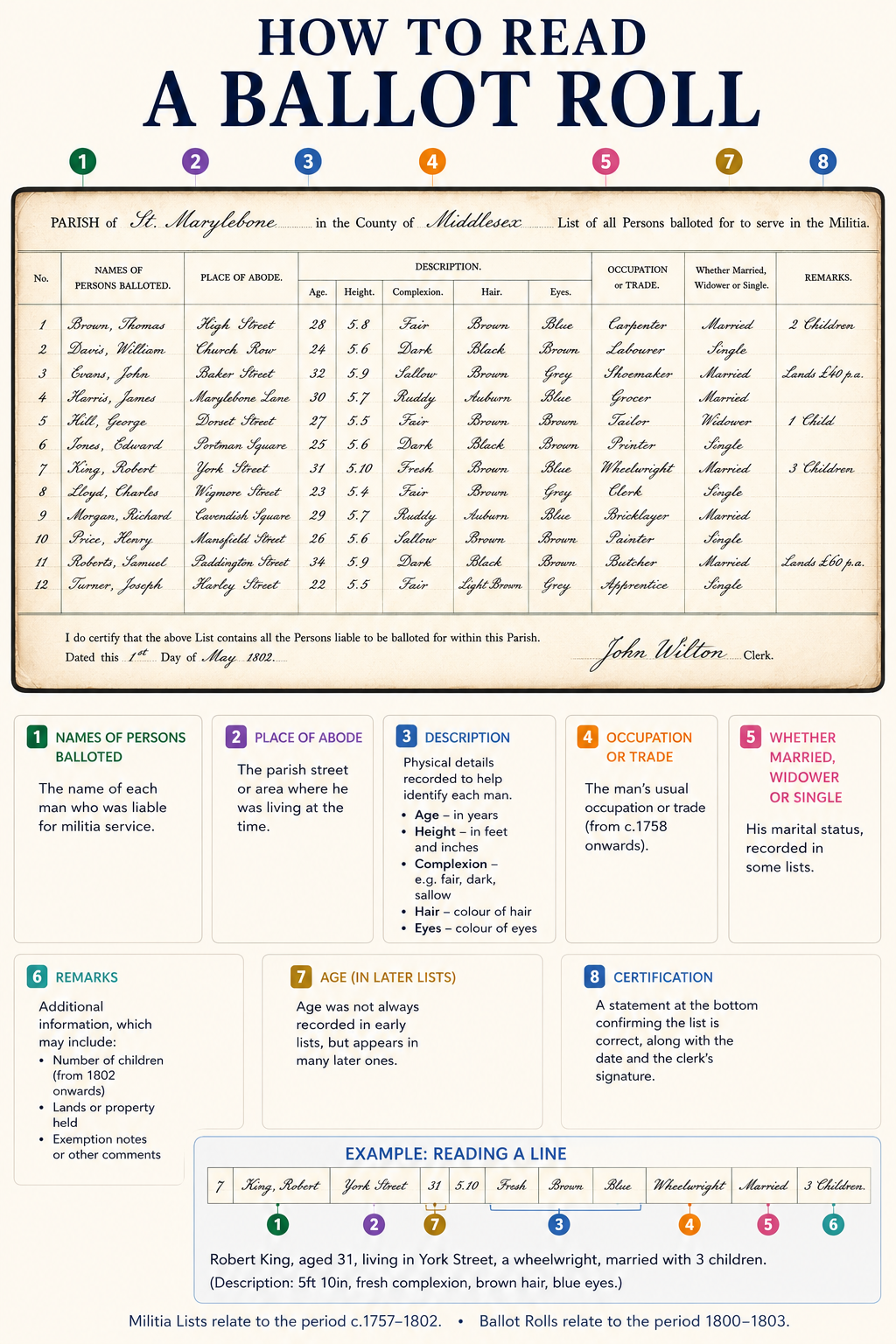
Key Research Tips
- In theory all adult able-bodied males between the ages of 15 and 60 should appear in the ballot lists although the earlier lists only detail those that attended the muster.
- The wealthy often evaded service and certain professions such as the clergy, teachers and apprentices were excluded from the earlier ballots.
- Those deemed physically unfit or impoverished were not considered for service.
- The militia was funded by local rates and sometimes from proceeds from the land tax. Relevant references may be found in series E 182 (Land Tax assessments) at the National Archives.
- A militiaman could serve between three and five years and thereafter he might transfer to the regular army. Many just attended a few weeks training each year unless called up for service during wartime.
- Militia lists and payments might be found amongst the parish overseer accounts. Local militia activity may also be mentioned in parish records such as vestry minutes, overseer’s books or poor law records.
- Also consult the Militia Relief Orders which provided relief for families of poorer serving militiamen. The Orders will give the name of the soldier and his wife and occasionally the names of the children and their ages. These records are found in poor law records or overseer’s accounts.
Related Militia Resources
- Posse Comitatus Returns (1798)
- Levee en Masse Returns (1803-1804)
These lists of reservists were compiled during the Napoleonic Wars (1803-1815) in preparation for a possible French invasion. They include the names of all men available for military service and are found in county record offices and some published sources.
Muster books and pay lists from other volunteer forces such as the Yeomanry, The Volunteers and the Local Militia can be found in series WO 13 at The National Archives and in records found in County Record Offices and other local collections.
The End of the Militia
Following the Militia Act of 1852, the militia remained a standalone county force until the Cardwell Reforms of 1872, which saw the militia affiliate with regular county regiments of the British Army. The final major change came with the Haldane Reforms of 1908, which transformed the militia into the Special Reserve, effectively ending the traditional county militia system. Subsequent records are found within the Special Reserve or regular army archives.
Key Reference Books:
- Gibson, Jeremy & Dell, Alan. Tudor and Stuart Muster Rolls: FFHS, 1989. The book provides a directory of where surviving muster rolls from the Tudor and Stuart periods (16th and 17th centuries) are held in archives and libraries across the British Isles (England, Scotland, Wales and Ireland).
- Gibson, Jeremy & Medlycott, Mervyn. Militia Lists and Musters, 1757-1876: A Directory of Holdings in the British Isles: FFHS, 2000. The book provides a directory of where militia lists and muster rolls from 1757 onward are held in archives and libraries across the British Isles (England, Scotland, Wales and Ireland).
Additional Resources
The following GenGuide sources could assist in researching militia records:
Where Found
The National Archives
The archives holds militia muster records and related military records from 1522 onwards.
- Series SP 12, State Papers Domestic, Elizabeth I, 1558-1603. The series also contains many larger items of considerable significance including certificates of musters 1569-1573.
- Series SP 14, State Papers Domestic, James I, 1603-1640. The series includes musters of troops for Count Mansfeldt’s expedition in 1624.
- Series SP 16, State Papers Domestic, Charles I, 1625-1649. Many of the records relate to musters.
- Series E 101, King’s Remembrancer: Accounts Various, c1154- c1830. The Army, Navy and Ordnance records include muster lists and wages for war lists in E 101. The Medieval Soldiers database contains more searchable information.
- Series WO 12, General Muster Books and Pay Lists, 1731-1878. This series comprises muster books and pay lists of the Household troops, the cavalry, Guards and the regular infantry regiments of the line.
- Series WO 13, Militia and Volunteers Muster Books and Pay Lists, 1778-1878. This series comprises muster books and pay lists of militia and volunteer regiments. It covers county militias for England, Wales, Scotland and Ireland.
- Series WO 16, Muster Books and Pay Lists, 1877-1898.
- Series WO 25, Secretary of State for War, Commissary General of Musters, 1660-1817.
- Series WO 68, Records of Militia regiments in Great Britain and Ireland, 1759-1925.
- Series WO 76, Records of Officers’ Services, 1764-1961. The series includes militia officer records.
- Series WO 96, Militia Attestation Papers, 1806-1915.
- Series WO 97, Soldiers Service Document. For the period 1760-1872 the documents are arranged alphabetically by name within regiment, including militia to 1854 (WO 97/1-1721).
- Series WO 437, Grenadier Guards: Registers, Muster Rolls, Description Books and Indexes, 1759-1999.
Records within series WO 76 are available to download free of charge as part of the Digital Microfilm Records or available online at Findmypast.
The name index covering series WO 97 is available at the TNA Discovery catalogue. First select advanced search and enter the name being searched. In the ‘Search for or within references’ box type WO 97 and then scroll down to ‘Held by’ and click ‘Search The National Archives’. Finally click the search button. Further filters appear on the search results screen.
County Record Offices
Most surviving Militia Ballot and Militia Lists are held at county record offices and local archives, although coverage is incomplete and varies by county. Tudor and Stuart muster rolls (1522-1649) may be found in both The National Archives and local archives as are later muster rolls (18th-19th centuries). Lord Lieutenant (or County Lieutenant) records can include militia records as the official had direct responsibility for organising and overseeing the local militia, especially after the Militia Act of 1757.
Period Covered
1285 – 1924
Genealogical Value
Militia Lists and Ballot Rolls
- Name of adult male liable for service.
- Age in later lists.
- Parish address.
- Lands and goods held in early muster rolls.
- Occupation or trade (from 1758).
- Marital status in some lists.
- Details of his children from 1802.
Service Records
- Name, parish address, age and date and place of birth.
- Occupation or trade of militia man.
- Rank of militia man.
- His Regiment or company.
- Dates of enlistment and discharge or death in service.
Further References
- Asplin, Kevin. (ed). The Roll of The Imperial Yeomanry, Scottish Horse & Lovats Scouts- 2nd Boer War 1899-1902: D, P &G Publishing, 2003 (An alphabetical list of 39, 800 men of these volunteer forces who enlisted for the 2nd Boer War together with medal clasp entitlement and remarks column)
- Barnes, Michael. Meonstoke & Hambledon Hundreds: Portsdown Regiment1626-1642: Michael Barnes, 2011
- Beckett, Ian. Britain’s Part-time Soldiers: The Amateur Military Tradition 1558-1945: Pen & Sword Books, 2011
- Bevan, Amanda. Tracing Your Ancestors in the National Archives: The National Archives, 2006
- Boynton, Lindsay. The Elizabethan Militia, 1558-1638: Routledge, 1967
- Chapman, Colin. Pre-1841 Censuses & Population Listings in the British Isles: Lochin Publishing, 2002 (Preview available from Google Books)
- Faraday, M.A. The Herefordshire Musters of 1539 and 1542: M.A. Faraday, 2004
- Gibson, Jeremy & Medlycott, Mervyn. Militia Lists and Musters, 1757-1876 (5th ed): The Family History Partnership, 2013
- Gibson, Jeremy & Dell, Alan. Tudor and Stuart Muster Rolls: Federation of Family History Societies, 1989
- Norfolk, R. W. S. Militia, Yeomanry and Volunteer Forces of the East Riding 1689-1908: East Yorkshire Local History Society, 1965
- Oates, Jonathan. Tracing Your Ancestors from 1066 to 1837: Pen and Sword Books, 2012
- Roper, Michael. The Records of the War Office and Related Departments, 1660-1964: Public Record Office, 1998
- Spencer, William. Records of the Militia and Volunteer Forces: PRO Readers Guide, 1997
- Spencer, William. Army Records: A Guide For Family Historians: The National Archives, 2008
Websites
The National Archives Research Guide
How to look for records of Militia. This guide will help you find records containing details of officers and ordinary soldiers who served with the Militia between 1522 and 1907.
The National Archives Research Guide
How to look for records of Medieval and early modern soldiers. Use the advice in this guide to find records of individual soldiers from the medieval and early modern periods. The guide covers records from the 12th to the 17th centuries, including the Civil War.
The National Archives Research Guide
How to look for records of Volunteers and Territorials. Use this guide to discover how to find records of people serving in the Territorial Army and its predecessors, from the late 18th century until the mid-20th century.
National Army Museum
Civilian soldiers. Throughout its long history, the British Army has relied on part-time soldiers to support its operations, guard British shores and maintain law and order. But the way part-time military units recruited and how they were used was sometimes controversial.
Dorset Magazine
How records of the Dorset Militia can trace your ancestry. Chloe O’Shea, author of Discover Your Dorset Ancestors, reveals how records of the Dorset Militia can help shed new light on your family tree from the 18th century and even tell you about their lives.
Maximapedia
Militia of the United Kingdom
Ramsdale Family Register
The site provides a detailed overview of British militia records and lists from the 18th and early 19th centuries, focusing on their value for family and local historians.
Lancashire Archives
Research Guide: Militia and volunteers from 1757. Sources for the history of the militia and volunteer regiments in Lancashire.
The Rifles Berkshire and Wiltshire Museum
The Militia, Volunteers and Territorial Army. History of the militia and the Berkshire Militia.
UK Military Family History Online
The website is an online resource providing help for users researching military family history. It provides a collection of 1,589 links to various websites offering online information across a wide range of categories relevant to military family research, such as muster rolls, discharge papers and pension records.
Bob Sanders
A Brief History of The Glamorgan Militia, 1759 to 1881. This is intended only to give the reader a brief introduction to the history of the Royal Glamorgan Light Infantry Miltia for the period prior to the regiment becoming the 3rd Battalion, The Welch Regiment under the Cardwell Reform of the Army in 1881.
National Army Museum
Charles Gray’s militia ballot form, ordering him to appear of find a substitute, 1826.
The Queen’s Royal Surrey Regimental Association
Militia And Volunteers. The Background.
Military Wiki Fandom
Militia Artillery units of the United Kingdom and Colonies.
Henley Business School
Medieval Soldier. Did You Ancestor Serve in the Garrisons of Normandy 1415-1450?, by Anne Curry.
Henley Business School
Medieval Soldier. Was Your Ancestor on the Agincourt Campaign With Henry V?
Online Databases
- British Army Service Records, 1760-1939. Search more than eight million British Army documents from eleven different series of records from The National Archives and the Scots Guards. Expect to find officers and other ranks in various Army forms including attestation papers, medical forms, discharge documents, pension claims, and proceedings of regimental boards. The records can tell you when your ancestor joined and left the army, as well as details about where he came from and his military service. The dataset includes WO 96 – Militia service records 1806-1915.
- Lincolnshire, Kesteven Militia Ballot List, 1824. These transcripts were created by the Lincolnshire Family History Society from original records held at the Lincolnshire Archives.
- Northamptonshire Militia Lists, 1762-1819. The transcripts were created from the original militia lists held by the Northamptonshire Archives.
- City of York Militia & Muster Rolls 1509-1829. This collection includes muster rolls, arms rolls, militia lists, and The Association and York Armed Association lists.
- Norfolk Borough Records 1317-1981 Browse. Browse through a variety of Norfolk borough records including Militia papers, Muster rolls and books, Muster lists and notes, Muster orders and Muster returns.
- Plymouth Militia Records 1625-1831. The records are for the following parishes St Budeaux, Ugborough, Wembury and Yealmpton.
- Jersey, 1815 Militia Survey.
- Scotland, Ireland and Wales, Militia Attestation Papers, 1800-1915. This collection comprises attestation papers for recruits into the militia extracted from Series WO 96 held at The National Archives.
- UK, British Army Muster Books and Pay Lists, 1812-1817. This series comprises selected muster books and pay lists of the Cavalry, Foot Guards and regular infantry regiments of the line.
- Westminster, England, Militia Records, 1779-1815. This collection contains militia records from Westminster, England between 1779 and 1815. Types of records available may include: Pension records, Registries of principals and substitutes and Certificates of military service.
- Cornwall, England, Militia and Sea Fencibles Index, 1780-1831. This collection contains information on soldiers who were registered for potential service in the Cornwall Militia and the Sea Fencibles, primarily during the French Revolutionary Wars (1792-1802) and the Napoleonic Wars (1799-1815).
- Dorset Records: Militia Lists, 1757-1860. This dataset is provided in association with the Dorset History Centre.
- Warwickshire Militia, 1776-1825. This database contains a collection of militia records from historic Warwickshire held by the Warwickshire County Record Office.
- West Yorkshire, Militia, 1779-1826. This collection includes a variety of militia-related records, including township payments to the militia, lists of officers, and lists of eligible men.
- Worcestershire, Militia Records, 1604-1914.
- Buckinghamshire, England, Napoleonic Register: Posse Comitatus, 1798. The Posse Comitatus, or military census, is a record of all men in Buckinghamshire who could be recruited for military service. The census pertains to men between the ages of 15 and 60 and excludes Quakers, clergymen, and those already in the military.
Forces War Records
UK, Militia Attestation Papers 1806-1915. Search attestation forms from which were filled out at recruitment and, in most cases, annotated to the date of discharge to form a record of service. These records form part of series WO 96 held at The National Archives
- 1813 Militia List.
- 1876 Historical Records of the First Regiment of Militia (Third West York Light Infantry).
- History of the Old County Regiment of Lancashire Militia.
- Lancashire Militia Roll of Officers of the Old Country Regiment 1642-1889.
- Officers of the Local Militia of Great Britain 1811.
- The History of the North York Militia (Fourth Battalion Alexandra Princess of Wales’s Own).
- Historical Record Of The 1st Royal Lancashire Militia.
FamilySearch
United Kingdom, Militia Service Records, 1806-1915. This collection includes records of militia servicemen from the United Kingdom. The TNA record series number is WO 96. This collection is done in cooperation with Findmypast.
Henley Business School
Medieval Soldier Database, 1369-1453. Search service records of soldiers serving the English crown who fought in the Hundred Years War between 1369 and 1453. The following record series held at The National Archives were used to compile the database:
- Muster Roll: From muster rolls extracted from Exchequer Accounts, held at TNA in series E 101 covering 1369-1453.
- Protection Database: Taken from the treaty rolls and only showing an intention to serve, held at TNA in series C 67 and C 71 covering 1369-1453.
- Normandy Garrison Database: Extracted from mainly French repositories relating to occupation of Normandy, covering 1415-1453.
- The Agincourt Roll: Contains the names of some retinue leaders and men-at-arms but no archers who were with Henry V in the battle of Agincourt in 1415.
Friends of Devon’s Archives
1715 Militia Assessments and related documents. Search names of property owners required to contribute in 1715 towards the costs of maintaining the militia.
GENUKI
Devon Militia and Volunteer Lists. Search militia, volunteer and deserter lists.
Cornwall Online Parish Clerks
Muster Rolls Database, 1569. Search lists of all able men between the ages of 16 and 60. Only the hundreds of Powder, Pydar, West and East limited themselves to able men. The other hundreds included unable men.
The Rifles Berkshire and Wiltshire Museum
Militia Search: Search Discharge Records and Militia Records going back to the mid-19th century
Yeovil’s Virtual Museum
1569 Muster Roll. Search the men of greater Yeovil listed in the Muster Roll of 1569 together with the arms and armour they were required to provide. Also included is a brief glossary of terms used.
Worcestershire Archives
Kidderminster St Mary’s Militia List, 1824-1831. Explore transcribed names taken for the militia between the ages of 18 and 45 at St Mary’s, Kidderminster, 1824-1831.
Ramsdale Family Register
The site offers indexed muster rolls for specific county militias (e.g., Durham, Lancashire, Yorkshire) and provides access to a large collection of militia muster records from 1781–1782, totalling about 58,000 records.
CD Roms
Genfair
The company offers a selection of militia and muster records for purchase or download for a number of counties including:
- Dorset Tudor Muster Rolls 1539, 1542 and 1569
- Somerset Muster Roll 1569
- Surrey Muster Rolls (1544–1684)
- Wiltshire Militia Orders 1759–1770
- Hertfordshire Militia Ballot Lists
S&N Genealogy Supplies
The company offers a range of militia and muster records on data CDs and as instant downloads. Search the catalogue for muster rolls and militia lists for various counties and periods.
The EurekA Partnership
The company supplies published militia and muster records for several English counties.
Northamptonshire Record Society
Northamptonshire Militia Lists 1777, edited by Victor Hatley. Transcriptions of the lists compiled by parish constables in each town or village, with analyses of crafts and trades for each Hundred.
Buckinghamshire Record Society
Buckinghamshire Posse Comitatus 1798, edited with an introduction by Ian F.W. Beckett. A military census of able-bodied men between the ages of 15 and 60, not engaged in any military capacity, made during the Napoleonic Wars. Contains over 23,500 names arranged under places, giving occupations.
Berkshire Family History Society
Berkshire Militia, men enrolled 1807 & 1808. This booklet contains a list of those men chosen by ballot to serve in the Berkshire Militia in late 1807 and early 1808 together with the parish, or group of parishes, for which they were to serve.
