
Nature of Source
Introduction
The records of the Overseers of the Poor provide a wealth of information for family historians researching ancestors who may have received poor relief. The records document both the money collected for the poor from parishioners and the aid distributed to those in need, whether as cash payments or in-kind support such as food and clothing. The records provide an insight into the administration of poor relief and into the lives of those receiving assistance.
The Origins of Poor Relief
The responsibility for supporting the poor fell to the parish authorities following the introduction of the Elizabethan Act for the Relief of the Poor (1598) and the Poor Law Act (1601), collectively known as the Old Poor Law. The Laws established a parish level system of poor relief funded by a local tax (the poor rate) collected from property owners within each parish. Under the laws a crucial distinction was made between the ‘underserving’ and ‘deserving’ poor. The ‘undeserving’ such as able-bodied beggars, vagrants or habitual drunkards faced workhouses or punishment which could include imprisonment, flogging or transportation to colonies. The ‘deserving’ poor such as the elderly, sick, widows or orphaned children were offered parish assistance. An important development came with the Act of Settlement and Removal (1662), which introduced settlement certificates which were used to prove a person’s entitlement to poor relief in a particular parish.
Key Overseer Records
- Rate Books detail the chargeable properties within the parish, from which the poor rate was collected.
- Account Books are registers containing details of payments to named individuals for rent, clothes, health expenses and funeral costs, along with justifications for their assistance (outdoor relief)
- Payments made to the aged and to widows.
- Registers of apprenticed pauper children which detailed placements and guardianship of the child.
- Settlement Certificates are documents issued to confirm a person’s legal place of settlement.
- Removal Orders document individuals or families being removed from a parish where they had no legal right to settle.
- Bastardy Orders are enforcement orders holding a putative father financially accountable for the upbringing of an illegitimate child.
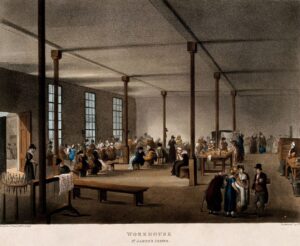
- Parish Workhouse Records (Indoor relief). The overseers became responsible for the parish workhouse following the Knatchbull Act of 1722 (Poor Relief Act 1722). The Act mandated every parish to establish a workhouse (or jointly with neighbouring parishes). The Act required individuals seeking relief to enter a workhouse in order to receive assistance under the contentious ‘workhouse test’ rules. Inmates were required to work in exchange for food and shelter.
- Quarter Sessions were responsible for supervising the administration of the Poor Law and acted as a court of appeal for decisions taken by petty sessions. Records often include disputes over settlement and removal of paupers and other Poor Law matters.
Duties of the Overseer
The 1598 Act created the post of the Overseer of the Poor. The official was appointed annually by the parish vestry, which consisted of the church minister, churchwardens and prominent local members of the parish. The names of the appointees were then approved by Justices of the Peace. The key duties included:
- Estimating the amount of poor relief money needed and setting the poor rate accordingly.
- Collecting the poor rate from parish members.
- Distributing poor relief to those in need such as the elderly, sick or disabled outside of the workhouse (Outdoor relief).
- Managing the parish poorhouse or workhouse.
- Organising the collection of other taxes.
- Issuing settlement certificates and removal orders.
- Enforcing bastardy orders.
- Arranging apprenticeships for children.
The Speenhamland System (1795-1834)
A unique system of outdoor relief was introduced in Berkshire in 1795 following dangerously high levels of discontent amongst the rural poor due to rising food prices and low wages. Fears of unrest led to Berkshire magistrates meeting in 1795 at the Pelican Inn, Speenhamland, Newbury to enact a new system of ‘outdoor’ relief. The system worked by supplementing a poor rural labourer’s wage with a top-up paid from the poor rates based on the price of bread and the number of children. The system was widely adopted in southern England but less so in other regions. The Poor Law Reform Act of 1834 (New Poor Law) ended the practice. The names of those receiving relief under the system can be found in the poor law records held in the relevant local archive.
Using Overseer Records for Research
Overseer of the Poor records can help identify key events that may not be found in other sources. For example:
- Payments to a widow may indicate the death of her husband and could help identify his burial record.
- A child’s birth may be recorded in relief accounts.
- Bastardy bonds can reveal the reputed father of an illegitimate child which is valuable information if the parish register has not stated the name of the father of an illegitimate child.
- Settlement certificates can help track a person’s movements between parishes.
- Workhouse records reveal details about a person’s fall into poverty.
The New Poor Law (1834)
The Poor Law Amendment Act of 1834, commonly known as the New Poor Law, drastically changed the administration of poor relief. It ended direct parish relief established by the Poor Relief Act of 1601 and introduced a more centralised uniform system. Key features of the New Poor Law include:
- Formation of Poor Law Unions composed of about six parishes. Each union was administered by a locally elected body of Board of Guardians, which replaced the role of Overseers of the Poor. Members of the Boards of Guardians were sometimes referred to as ‘Guardians of the Poor’.
- Each union was required to establish a workhouse to provide poor relief with each board responsible for its own workhouse as well as nursery for infants, pauper schools and infirmaries.
- Relief outside workhouses (outdoor relief) was largely abolished for able-bodied individuals, who were required to enter workhouses to receive aid.
- The boards were composed of elected and ex-officio members such as Justices of the Peace.
- The system was funded through local poor rates.
Records of those in need of assistance prior to 1834 will appear in the overseer of the poor accounts and those in need after 1834 appear in workhouse records or board of guardians minutes.
Also see
Apprenticeship Indentures, Parish
Bastardy Documents
Rate Books, (Parish)
Settlement Certificates/Examinations and Removal Orders
Workhouse Records (Poor Law Unions)
Where Found
Local archives hold a variety of poor law records dealing with the administration of poor relief at the parish level. Records typically include:
- Overseer Account Books detailing poor rates collected and distribution of poor relief.
- Settlement Certificates and Examinations and Removal Orders.
- Bastardy Bonds, Examinations and Orders.
- Apprenticeship Indentures for apprenticing poor children.
- Workhouse Records.
- Vestry Minutes: which may include decisions on poor relief.
- Quarter Sessions Records for disputes over settlement or poor law decisions.
Period Covered
1572 – 1834
Genealogical Value
- Names of individuals and family members including children
- Ages of individuals
- Occupations
- Residences and parishes of origin or settlement
- Places of birth
- Name of reputed father in bastardy cases
Further References
- Aschrott, Paul Felix. The English Poor Law System, Past and Present: Knight 1902 (Available to read online or download at the Internet Archive)
- Bagley, John J & Bagley, Alexander John. The English Poor Law: Macmillan, 1968
- Beier, Lucinda. The Problem of the Poor in Tudor and Early Stuart England: Routledge, 1983
- Boyer, George R. An Economic History of the English Poor Law, 1750-1850: Cambridge University Press, 1990
- Brundage, Anthony. The English Poor Laws 1700-1930: Palgrave, 2002
- Burlison, Robert. Tracing Your Pauper Ancestors: Pen and Sword Books, 2009
- Cohen, Deborah, Family Secrets: Living with Shame from the Victorians to the Present Day: Viking, 2013
- Cole, Anne. Poor Law Documents Before 1834: Federation of Family History Societies, 2000
- Englander, David. Poverty and Poor Law Reform in 19th Century Britain, 1834-1914: From Chadwick to Both: Longman, 1998
- Fitzgerald, Michael. Ragged London: The Life of London’s Poor: The History Press, 2011
- Fowler, Simon. Poor Law Records for Family Historians: Family History Partnership, 2011
- Gibson, Jeremy & Hampson, Elizabeth. Specialist Indexes for Family Historians: Federation of Family History Societies, 2000 (Preview available from Google Books)
- Gibson, Jeremy (ed). Banbury’s People in the Eighteenth Century: From Records and Accounts of the Overseers of the Poor 1708-1797 and other Lists and Sources”, edited by Jeremy Gibson: Banbury Historical Society, 2019
- Hawkings, David. Pauper Ancestors: A Guide to the Records Created by the Poor Laws in England and Wales: The History Press, 2011
- Hindle, Steve. On the Parish? The Micro-Politics of Poor Relief in Rural England 1550-1750: Oxford University Press, 2009
- Hitchcock, Tim & Black, John. Chelsea Settlement and Bastardy Examinations, 1733-1766: London Record Society, 1999
- Leonard, E M. The Early History of English Poor Relief: F. Cass, 1965(Available to read online or download at the Internet Archive)
- McLaughlin, Eve. Annals of the Poor: Federation of Family History Societies, 1990
- McLaughlin, Eve. The Poor are Always With Us: Varneys Press, 1994
- Osborn, Helen. Our Village Ancestors: A Genealogist’s Guide to Understanding the English Rural Past: The Crowood Press, 2021
- Paley, Ruth. My Ancestor Was a Bastard: A Family Historian’s Guide to Sources for Illegitimacy in England and Wales: Society of Genealogists, 2004
- Raymond, Stuart. My Ancestor was an Apprentice: Society of Genealogists, 2010
- Raymond. Stuart A. Tracing Your Poor Ancestors: A Guide for Family Historians: Pen and Sword Books, 2020
- Rose, Michael E. The English Poor Law, 1780-1930: David and Charles, 1971
- Short, David. (Ed). Ashwell Overseers’ Accounts, 1676-1722: Hertfordshire Record Society, 2022
- Sim, Alison. Masters and Servants in Tudor England: The History Press, 2006
- Slack, Paul. The English Poor Law, 1531-1782: Cambridge University Press, 1995
- Stubley, Peter. A Pauper’s History of England: 1,000 Years of Peasants, Beggars and Guttersnipes: Pen & Sword Books, 2015
- Tate, William Edward. The Parish Chest: Phillimore, 1983 (Preview available from Google Books)
- Thompson, Kathryn. Apprenticeship and Bastardy Records: Historical Association, 1997
- Tomkins, Alannah & King, Steven. The Poor in England 1700-1850: An Economy of Makeshifts: Manchester University Press, 2003
- Welbank Fowle, Thomas. The Poor Law: Macmillan, 1893 (Available to read online or download at the Internet Archive)
- Wise, Sarah. The Blackest Streets: The Life and Death of a Victorian Slum: Vintage, 2009
TNA Research Guide: Poor and the Poor Laws
The EurekA Partnership: Various titles containing transcriptions of Poor Law records covering Bedfordshire, Berkshire, Buckinghamshire, Gloucestershire, Northamptonshire, Oxfordshire, Surrey, Warwickshire and Worcestershire
Websites
The National Archives Research Guide
How to look for records of Poverty and the Poor Laws. Use this guide for advice on how to locate poor law records at The National Archives, as well as documents in which issues of and connected to poverty are discussed more broadly.
British History Online
A History of the County of Oxford. Parish Government and Poor-Relief. The extract focuses on parish government and poor relief in Oxford.
Manchester Archives Guide
The site discusses the administration of the Poor Law before 1834 in Manchester, which was the responsibility of the parish or township and details the records available at the Central Library. The Archives site has an online searchable catalogue list of industrial schools, hospitals and workhouses.
Devon Heritage Centre
Information Leaflet: Poor Relief. The guide is about poor relief , particularly before the Poor Law Act of 1834. It discusses the history, records and significance of the Old Poor Laws.
Surrey History Centre
Poor Law Records.
Durham Record Office
Poor Law records. A guide to Poor Law records held at Durham Record Office, especially those with potential for family history research.
Norfolk Record Office
Parish records of the poor.
Public Record Office of Northern Ireland
Information leaflet. Poor law records. The information leaflet below gives an overview of poor law records.
The Victorian Web
The 1601 Elizabethan Poor Law, by Marjie Bloy, Ph. D.
The Workhouse
The Old Poor Law, by Peter Higginbotham. The webpage provides an overview of the Old Poor Law system in England, from its origins in the 15th century to the early 19th century.
Pembrokeshire Historical Society
Aspects of The Old Poor Law in Pembrokeshire, by Simon Hancock.
Sheffield Archives
Poor law research guide.
Westminster Archives
Researching family history at the Archives Centre: Parish and Workhouse records and Poor Law. Parish records can be a rich source of information as they include apprenticeship indentures, school records, settlement papers, bastardy bonds, workhouse and charity records.
LSE Library
British Library of Political & Economic Science. The library holds a large collection of pamphlets on the Poor Laws and the origins of the welfare state and several collections of primary source materials relating to the poor laws such as records of the Evesham Board of Guardians and Irish poor law records.
London Lives
Churchwardens and Overseers of the Poor Account Books. The webpage provides an introduction to and information about Churchwarden’s and Overseers of the Poor Account Books as well as the role of overseers.
London Lives
Researching Poverty.
London Lives
The Poor Law and Charity: An Overview.
London Lives
The Parish Poor.
London Lives
Workhouses.
Brigham Young University
Poor Law Records. The guide provides a history of poor laws and where to find online poor law records listed county-by-county.
Social Policy
British Social Policy1601-1948. The article provides a comprehensive, chronological overview of the development of British social policy up to 1948, focusing on the evolution of welfare, poor relief, poor laws, public health, education and local government.
John Martin of Evershot
The Overseer of the Poor.
Newcastle University
Pauper Lives in Georgian London and Manchester. Sections include: ‘Infant Deaths’, ‘Workhouse Lives’ and ‘Death and Disease’
Online Databases
Findmypast
Datasets include:
- London Lives, Culture & Society 1680-1817. London Lives chronicles the lives of Londoners through the exploration of a variety of sources including criminal registers, session papers, ordinary’s accounts from Old Bailey, apprentice records, coroner inquests, workhouse minutes, Register of admissions to workhouse, clerks’ papers, Churchwarden’s account books, Vestry minute books/vestry minutes, Register of removal orders, Pauper examination books/examination books, bastardy bonds and more.
- London Poor Law Records, 1581-1899. Poor Law abstracts from 66 London parishes compiled by genealogist Cliff Webb. These poor law abstracts include Workhouse Admission and Discharge Registers; Bastardy/Affiliation Orders; Bastardy Bonds and Examinations as well as Quarter Sessions and Quarter Sessions Appeals.
- Kent Poor Law and Occupations. Search an index of poor law and occupation records including church registers, alehouse keepers’ licenses and poor law documents.
- Devon Social & Institutional Records. Search the of records to find paupers and vagrants, apprentices, peddlers and tradesmen. Datasets include Vaccination Registers against smallpox for various dates between 1870 and 1905.
- Devon, Plymouth & West Devon Parish Chest Records 1556-1950. Records from the parish chests of Plymouth and West Devon including: Examinations, Jury Lists, Settlement Papers, Bastardy Papers and Overseers and Churchwardens’ Accounts.
- Wiltshire Social & Institutional Records 1123-1968. Explore an index of miscellaneous social and institutional records from Wiltshire including poor law records.
- Southwark, St Saviour Poor Relief 1818-1821. The dataset contains nearly 4,000 records that list the details of individuals who applied for outdoor relief from the parish of St Saviour’s Poor Law authority.
- Yorkshire, Sheffield Social and Institutional Records 1558-1939. List of paupers, 1751-1808; List of able poor, 1843.
- Norfolk Parish Chest Records 1300-1990 Browse. Explore a variety of parish chest records from Norfolk including Guardian’s accounts and Overseers’ accounts, Poor rate books, Lists of paupers, Lists of recipients of meal allowance, Lists of paupers receiving relief, Pauper maintenance orders, Poor law papers and Workhouse accounts.
- Norfolk Borough Records 1317-1981 Browse. Browse through a variety of Norfolk borough records including Guardians of the poor board minutes, Overseers’ accounts, Overseers’ relief, Poor rate books and Admission books..
- Middlesex Poor Law Records, 1699-1846. Search Poor Law records for 10 parishes in the west of the ancient county of Middlesex. The records include settlement examinations and removals as well as bastardy orders and bastardy bonds.
Ancestry
Datasets include:
- London, England, Poor Law and Board of Guardian Records, 1738-1926. This collection includes a huge variety of different records created as a result of the Poor Laws in London including: Registers of relief to wives and children; Registers of indoor poor; Registers of deserted children; Registers of children; Registers of children boarded out or sent to various other institutions. Original data produced by permission of The London Archives.
- Westminster, London, England, Poor Law Registers, 1561-1900. This collection contains records pertaining to the Poor Laws in the parishes of Westminster.
- Kensington and Chelsea, London, England, Poor Law Records, 1695-1921.
- Glamorgan, Wales, Workhouse Registers, 1850-1920.
- Swansea and Surrounding Area, Wales, Poor Law Union Records, 1836-1916.
- Dorset, England, Parish Poor Law Records, 1511-1997. This is a collection of records related to England’s Poor Laws. Both civil and ecclesiastical parishes are represented.
- Warwickshire Parish Poor Law, 1546-1904: This is a collection of parish Poor Law records that relate to disposition of relief in Warwickshire, England. Types of records include: Overseers’ accounts; Poor law papers; Parish account books; Poor rates; Lists of poor and apprentices; Charity deeds and accounts.
- England, Norfolk Poor Law Union Records, 1796-1900: This collection includes poor law union records from Norfolk, England.
- Ireland, Poor Law and Board of Guardian Records, 1839-1920.
Brigham Young University
Kinship and Poverty in Early Modern Britain. Finding Kinship among the Poor in Britain, 1600-1834. The database is a work in progress that aims to analyze the kinship connections of poor-relief recipients in the 17th and 18th centuries. It currently concentrates on a selection of parishes in Dorset.
London Lives
A fully searchable edition of 240,000 manuscripts from eight archives and fifteen datasets, giving access to 3.35 million names. Datasets include a variety of pauper records from the London parishes of St Botolph Aldgate, St Clement Danes, St Dionis Backchurch and Bridewell Royal Hospital.
Gloucestershire Archives
Genealogical Search. Records of the Overseers of the Poor including settlement papers, pauper apprenticeships and bastardy documents. Also try searching for a named individual at the Gloucestershire Archives Online Catalogue which includes the General Personal Names Index and other specialist indexes.
Bath Ancestors
Resources include Parish Poor Law Papers, 1694-1841. Search various parish poor law records including bastardy bonds, pauper apprenticeship indentures, removal orders, and records of outdoor relief.
FamilySearch
Norfolk Poor Law Union Records, 1796-1900. Poor law records for Norfolk county, England. Browse through 133,793 images.
Sussex Record Society
Database of Poor Law Records for West Sussex. The records primarily consist of Settlement and Removal 1662-1835 as well as records of bastard children and of the apprenticing and boarding out of pauper children.
CD Roms
Devon Family History Society
Rich man, poor man beggar-man, thief. A collection of over 63,000 entries from records held at Devon Record Office.
CHFHS
Cambridgeshire and Huntingdonshire Family History Society. Poor Law Papers and Masters and their Apprenticeships Apprentices Papers. Indices of Cambridgeshire Poor Law Papers, Master and Apprentices, Settlement and Bastardy Papers.
East Surrey Family History Society
Battersea Poor Law Records. Index to Orders of Justices 1700-1772 (Settlement) and Index to Apprenticeship Records 1602-1902.
West Surrey Family History Society
Surrey Poor Law Index & Calendar. The CD contains an Index of over 84,000 entries (including Place Names) and a Calendar of all known Poor Law Records for Non-Metropolitan Surrey.
Lincolnshire Family History Society
- Lindsey Quarter Sessions Poor Law Papers 1702-1703 & 1730-1848. Full transcriptions of settlement examinations, abstracts of removal orders, vagrancy passes, bastardy documents, some settlement certificates, apprenticeship indentures, maintenance orders, and other miscellaneous Poor Law material found in the Lindsey Quarter Sessions files.
- Kesteven Quarter Sessions Poor Law Documents 1700-1847. Abstracts and transcriptions of Poor Law material from the Quarter Sessions for this Mid-Lincolnshire area, for the years 1700 to 1847. It includes Removal Orders, Settlement Certificates, Vagrancy Passes, Apprenticeship Indentures, Bastardy Documents, and provides information from many parishes for which there are no surviving Poor Law documents.
Berkshire Family History Society
Berkshire Overseers’ Papers: Abbreviated transcripts of all the documents relating to the administration of the Poor Laws of Berkshire from 1601 to 1834 developed as part of the Berkshire Overseers Project. The CD contains comprehensive indexes for personal names, place names and occupations.
Parish Chest
Sussex Poor 1661-1850. Edited abstracts of all the poor law cases dealt with by justices at Quarter Sessions covering the whole county of Sussex.
