
Nature of Source
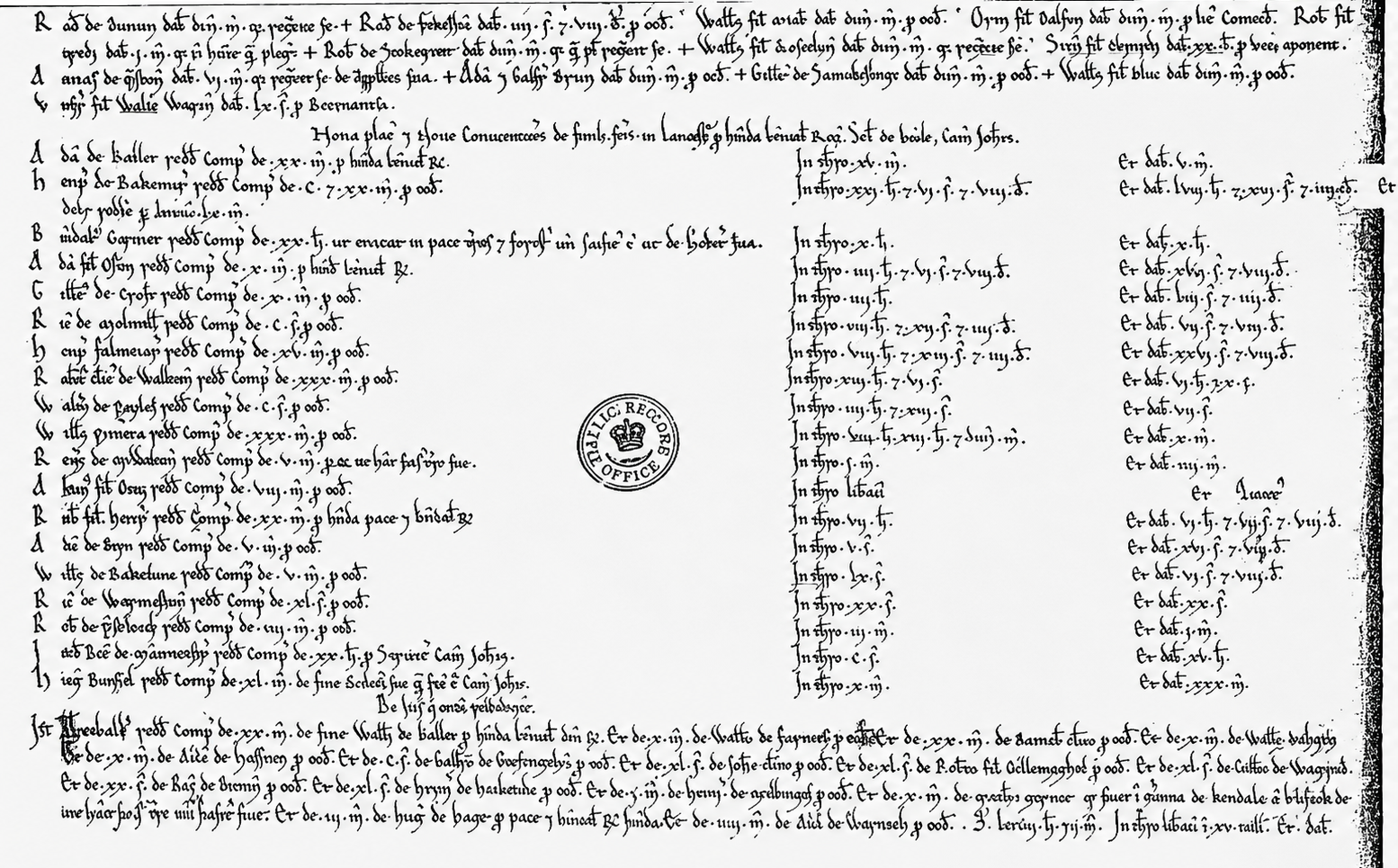
Pipe Roll, 1194. Richard I of England
Introduction
The Pipe Rolls were central to the operation of the medieval Exchequer and are among the earliest surviving records of royal administration in England. They consist of annual accounts of the Crown’s income, held by the Exchequer and survive from 1130 in the reign of Henry I. They form an almost continuous series from 1155 under Henry II into the early modern period.
Nature of the Records
The Pipe Rolls formally record the yearly financial accounts submitted to the Exchequer, principally compiled by sheriffs, but also by other royal officials such as escheators and bailiffs. The accounts are arranged largely by county and detail sums owed to the Crown and payments made. They are sometimes referred to as the Great Rolls of the Exchequer with a duplicate copy enrolled with the Chancery.
The rolls are written in Latin and are heavily abbreviated, particularly in the earlier medieval period. Their technical nature and formulaic structure can make them challenging to interpret.
The name “Pipe Roll” derives from the appearance of the rolled parchment membranes, which resemble a pipe when bound together.
They include a wide range of financial matters, such as:
- Farm of the county: Fixed annual fee paid by the sheriff or ‘farmer’ for the right to manage a county, collect its revenues and keep any surplus as profit.
- Fines and amercements (financial penalties): Imposed in county courts or subdivisions of hundreds and wapentakes.
- Feudal taxes and reliefs: Payments such as scutage, money paid by knights to avoid military service or feudal reliefs.
- Revenues from royal lands and rights.
- New debts (nova oblata): New fines, fees or debts owed to the King.
- Debts carried forward from previous years.
Genealogical Value
For family historians, Pipe Rolls have limited but important value. They mainly concern:
- Landholders and tenants-in-chief.
- Individuals fined or amerced in royal courts.
- People involved in financial or administrative dealings with the Crown.
They are most useful for tracing individuals of high social status or those engaged in landholding, legal disputes or royal administration.
Recusants in the Pipe Rolls
For the period 1581 to 1591, the Pipe Rolls include detailed records of fines levied against Roman Catholics (recusants) who refused to conform to the established Church. These entries often name individuals and their places of residence.
These records have been published by the Catholic Record Society in Records Series Volume 71: Recusants in the Exchequer Pipe Rolls, available to view on Internet Archive.
Where Found
- Series E 372, Exchequer: Pipe Office: Pipe Rolls, 1129-1832
- Series E 352, Exchequer: Pipe Office: Chancellor’s Rolls, 1162-1962
County Record offices
Published editions, calendars and extracts. Larger county archives may hold sets of the Pipe Roll Society publications.
Period Covered
1120 – 1833
Genealogical Value
- Names and family relationships.
- Land held.
- Especially good for the names of Tenants-in-Chief.
Further References
- Chambers, Paul. Medieval Genealogy: How to Find Your Medieval Ancestors: Sutton, 2005
- Introduction to the Study of the Pipe Rolls: Pipe Roll Society, 1966 (1884)
- Noble, Malcolm. A Practical Introduction to Medieval Genealogy: Bookcabin, 2026
Websites
Pipe Roll Society
Founded in 1883, the Society publishes editions of the Pipe Rolls (Great Rolls of the Exchequer) and of related medieval documents. The Society has published dozens of volumes since the 1880s, covering the earliest surviving Pipe Roll (31 Henry I, 1130) through the reigns of Henry II, Richard I, John, and into the early years of Henry III, up to around the 1220s in many cases.
Internet Archive
Free online access to ‘The Publications of the Pipe Roll Society’ volumes published by the Pipe Roll Society.
The National Archives Research Guide
How to look for records of Medieval financial records: pipe rolls 1130-c.1300. This guide will help you find and interpret government financial records known as pipe rolls from the medieval period held at The National Archives.
Medieval Genealogy
The section offers a clear expert guide to Chancery rolls (Close, Patent, Fine, Charter Rolls) especially useful for family historians.
Medieval Genealogy
The webpage offers a brief, practical guide on Pipe Rolls.
Pipe Roll Society
Introduction to Pipe Rolls. In this section you will find an extensive introduction to the production, form, content and use of the pipe rolls, prepared by Dr Richard Cassidy.
Foundation for Medieval Genealogy
The Foundation was established in 2001 by a group of British genealogists and historians with a special interest in the medieval period. The Foundation promotes the study of medieval genealogy and prosopography focusing on the period before 1500 AD. The FMG publishes a journal titled Foundations, which includes articles and reviews related to medieval genealogy. FMG has established a specialised collection of books, journals and offprints relating to medieval genealogy, heraldry and prosopography kept at the Centre for Medieval and Renaissance Studies in Oxford. The Library Catalogue provides a bibliographic catalogue of secondary source material for medieval genealogy and heraldry.
FamilySearch Digital Library
Introduction to the study of the pipe rolls : issued under the direction of the council of the Pipe Roll Society. The digital book includes a table of abbreviations used in Pipe Rolls.
Brepols Publishers
Bibliography of British and Irish History. The resource is regularly updated database of over 680,000 books, journal articles, essays, edited collections, theses, and reviews on British and Irish history from 55 BCE to the present day. Managed by the Institute of Historical Research and hosted by Brepols. It is highly useful for locating medieval primary source material and for printed calendars such as Chancery records and other medieval bodies like the Exchequer or General Eyres. Brepolis itself is a specialist online platform of academic databases focused on medieval and early modern European history and literature.
University of Michigan
The Middle English Compendium. The site contains three Middle English electronic resources: the Middle English Dictionary which is the world’s largest searchable database of Middle English lexicon and usage for the period 1100-1500; Bibliography of Middle English prose and verse; Corpus of Middle English Prose and Verse.
Family Tree
How to research medieval ancestors. Unlock centuries-old family history with this in-depth guide exploring medieval records across the British Isles. Discover how to trace local landowners, uncover hidden surnames and navigate key feudal documents.
The History of England
Glossary Of Medieval Terms.
Online Databases
TannerRitchie Publishing
Medieval and Early Modern Sources Online. The MEMSO database contains a large repository of medieval and early modern documents such state papers, calendars, charters, rolls, chronicles, accounts and correspondence from the archives of Britain, Ireland and continental Europe covering c.1100-1800.
Prosopography of Anglo-Saxon England
The database aims to provide structured information relating to all the recorded inhabitants of England from the late sixth to the late eleventh century. It is based on a systematic examination of the available written sources for the period. Sources include chronicles, saints’ lives, charters, inscriptions and coins.
University of Sheffield
Lands of the Normans in England, 1204-1244. The digital research project examines the 13th-century Anglo-French aristocracy between 1204 and 1244. It provides an interactive database of nearly 3,000 individuals and places, using historical records to map the redistribution of estates following the French annexation of Normandy. The project built the database using 2,000 individual documents collected from over 100 historical sources such as Charter Rolls, Patent Rolls, Feet of Fines, Cartularies, Chronicles and other primary sources.
Anglo-American Legal Tradition
Explore digital images of documents from Medieval and Early Modern England from The National Archives, 1200 to 1650. Series covered include:
- Series CP 40 (Court of common pleas plea rolls)
- Series KB 27 (Court of king’s bench plea rolls)
- Series E 159 and E 368 (Memoranda rolls)
- Series E 13 (Exchequer plea rolls)
- Series C 33 (Chancery orders and decrees)
- Series JUST 1, (Records of the General Eyre and commissions of assize)
- Series CP 25 (Feet of Fines)
CD Roms
Sussex Family History Group
Medieval Sheriffs of Sussex and Surrey 1066-1400. A detailed historical study by Michael Burchall FSG listing all the Sheriffs and explaining their role. The database is fully searchable by name, place and subject so that disparate references can be gathered together and will be useful tool particularly for medieval historians and genealogists.
