
Nature of Source
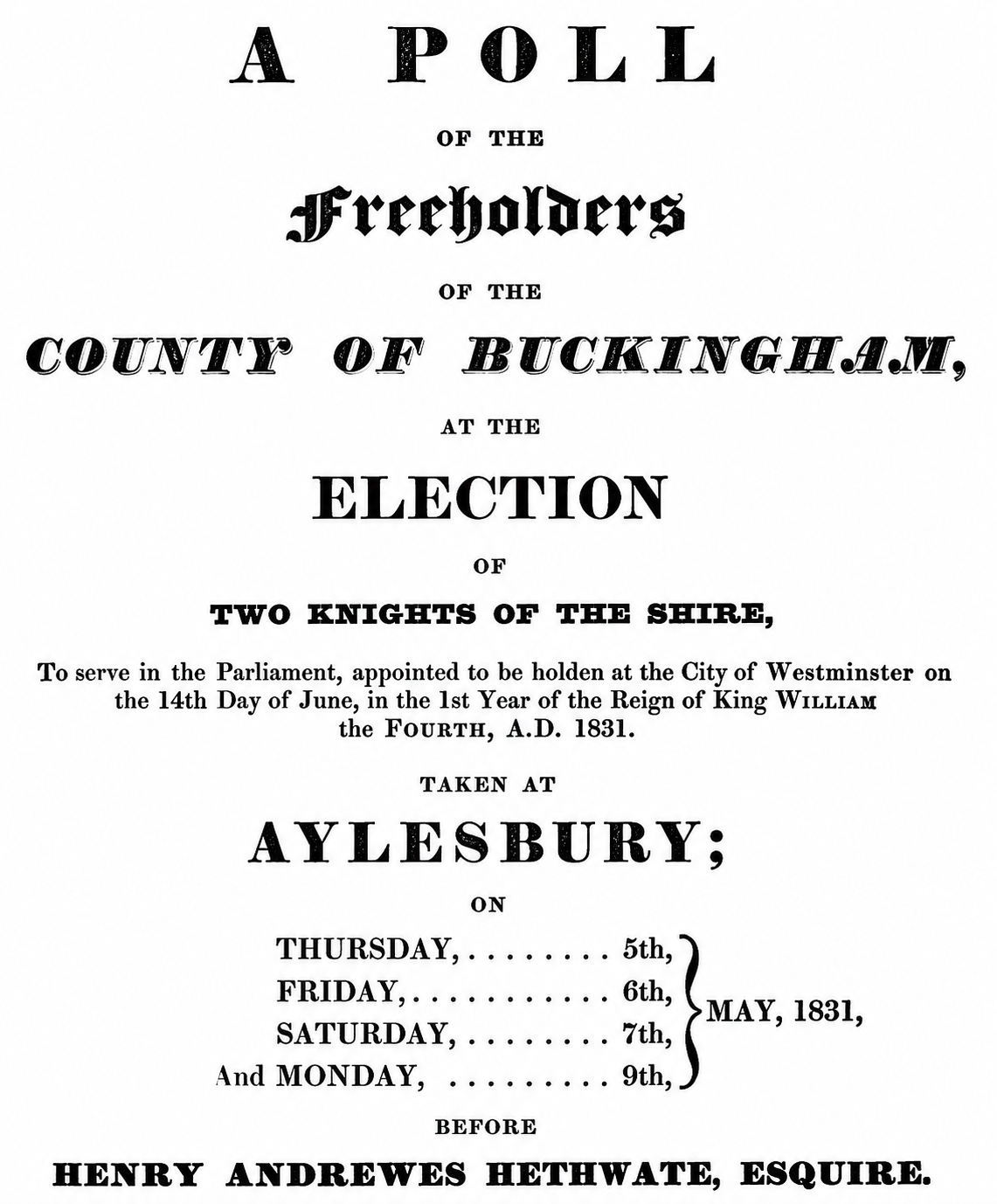
Poll of the Freeholders of the County of Buckingham, May 1831
Introduction
Poll books are a valuable but often overlooked resource for tracing male ancestors especially pre-census years. They help place individuals in a specific time and location. They provide not only the voters names and addresses but also an insight into their political life, property ownership and social status in the 18th and 19th centuries.
What Are Poll Books?
Poll books are records of parliamentary, county and borough elections and include the names of eligible voters and the candidates they voted for. These records were generally compiled after the vote took place and printed by local printers. The majority cover elections for:
- Members of Parliament (M.P.s), historically known as ‘Knights of the Shire’.
- County and borough elections (especially after 1843).
The earliest poll books date back to 1694, following a parliamentary act requiring that votes by eligible voters (freeholders) be recorded, including details of the qualifying property and the party and candidate voted for.
Who Could Vote?
Until the late 19th century, voting was confined to adult males over the age of 21 with eligibility closely linked to property ownership, land value or rental income. It is important to note these records represent only a small minority of the population of those with the legal right to vote and who actually voted in the election. Women and those without property were excluded.
- In some boroughs and counties, local customs extended voting rights to a broader group of male voters until the reforms of the 1832 Reform Act.
- Land Tax Assessments were often used to determine a person’s right to vote.
The 1832 Reform Act
The Representation of the People Act 1832, commonly known as the Reform Act, for the first time modestly extended the vote to non-property owning males. The Act widened the franchise to include those renting property at an annual rate of £10 or more per year but still only covered about 15% of the male population. Crucially, the 1832 Act also introduced Electoral Registers which recorded the names of all those entitled to vote and not just those who voted. These are often more comprehensive than poll books and became the principal means of recording eligible voters from that point forward.
Secret Ballot Act (1872)
The demise of poll books happened in 1872 following the introduction of the Secret Ballot Act. The Act introduced the secret ballot and abolished recording the names of voters and the recipients of their votes. This effectively ended the sometimes corrupting influence of open ballots. The Act brought an end to the use of public poll books in parliamentary elections which meant poll books were no longer published for the general public. The second Reform Act of 1867 extended the franchise to over 2.5 million men.
Survival of Poll Books
From 1711, original manuscript poll books for county elections were kept by clerks of the peace at local quarter session courts. Following the Parliamentary Elections Act 1843, poll books for both county and borough elections were deposited centrally with the Clerk of the Crown in Chancery.
In 1907 the entire centralised collection (mainly those deposited in the Crown Office after 1843) was arbitrarily destroyed and all that survives are those published by local printers after the poll. However, some local manuscript copies may still exist among quarter session records held in local archives. In larger urban areas the cost of printing poll books deterred publishers, leaving many largely populated urban areas without original manuscripts or published versions.
Common Abbreviations for Types of Freehold
The nature or ‘quality’ of the freehold is usually shown in abbreviated form. Also look out for combinations of these letters such as HG for House and Garden. Common abbreviations include:
- An(n): Annuity
- F: Farm
- G or Ga: Garden
- Gl: Glebe
- H: House
- Hs: Houses
- HG: House and Garden
- L: Land
- M: Messuage or Malting Mill)
- O: Orchard
- R: Rectory
- T: Tithe
- TG: Tithe and Glebe
- V: Vicarage
- W: Woods
Key Research Tips
- Poll books usually only a contain a small proportion of the population and only record those who actually voted. Therefore consider other polls such as those for Poor Law Guardians and School Board Members (from the 1870s onward) and parish elections for which generally all ratepayers could vote.
- Smaller polls were often published in local newspapers.
- Poll books were often hastily produced which resulted in mistakes being made with the spelling of names.
- Poll books come in a variety of formats and layouts which can be confusing with some arranged alphabetically by name or by parish or ward.
- From 1894 all ratepayers regardless of gender or wealth were entitled to vote in parish elections for which electoral registers were produced, although not all adults were ratepayers.
- The qualifying elector could have belonged to a guild or other types of fraternal societies or have been a freeman so consult freeman rolls and membership registers.
Scotland
Poll books in Scotland are rarer and less comprehensive than those in England. In Scotland fewer parliamentary elections were contested with many MPs elected unopposed and voting rights were more restricted, mainly to landowners or burgesses. As a result, poll books were not regularly produced. However, where Scottish poll books do exist, they generally follow formats similar to their English counterparts. Scottish poll books can be found in national and local archives and local studies libraries. The British Library and the Institute of Historical Research also have a limited collection.
Additional Resources
The following GenGuide sources could assist in researching Poll Book records:
Where Found
Institute of Historical Research
The Institute in London holds a substantial collection of British parliamentary printed poll books dating from a 1698 county election in Essex to the last known published poll book for the University of Cambridge constituency in 1882. Holdings for Ireland, Scotland, and Wales are also available but are significantly smaller than those for England.
British Library
The British Library holds a major national collection of poll books. Search the library catalogue for details of their holdings of poll books.
Guildhall Library
The library holds a large collection of poll books for London, as well as for other cities, towns, and counties across England.
Bodleian Library
The Bodleian Library, based at the University of Oxford, holds a collection of Poll Books. including a number of printed poll books. Use the Bodleian Libraries’ online catalogue (SOLO) to search for specific poll books by county, year, or constituency.
Society of Genealogists
The Society in London holds a large collection of poll books covering counties in England, Scotland and Wales.
County Record Offices
Local archives hold surviving original manuscript poll books for their area as well as printed or published versions.
Local Family History Societies
Many societies publish poll books and electoral registers for their area, available on CD or as downloads.
The National Archives’ Reference Library
The library holds a collection of printed poll books.
The London Archives
The library holds poll books for Middlesex and Westminster.
The National Library of Wales
The library hold poll books for Welsh constituencies. Search the library catalogue to find a specific poll book.
Period Covered
1696 – 1872
Genealogical Value
- Full name of voter (sometimes including middle names).
- District (some polls are listed by town, parish, ward, street or hundred).
- Address (occasionally full address shown and also note the place of abode might be different to qualifying address).
- Qualifying freehold address with nature or type of freehold (the type of freehold is usually abbreviated,).
- Details of votes cast.
- Occupation (borough elections only).
- Names of tenants and occupiers.
- Names of candidates (full names are given on the title page).
Further References
- Cheffins, Richard H. A. Parliamentary constituencies and their registers since 1832: a list of constituencies from the Great Reform Act with the British Library’s holdings of electoral registers together with the Library’s holdings of burgess rolls, poll books and other registers: British Library, 1998 (The publication is available to download here)
- Collett-White, James (ed). How Bedfordshire Voted, 1685-1735: The Evidence of Local Poll Books: Bedfordshire Historical Record Society, 2008
- Gibson, Jeremy & Rogers, Colin. Poll Books, c. 1696-1872: A Directory of Holdings in Great Britain: Federation of Family History Societies, 1994 (Preview available at Google Books)
- Munby, Lionel M. & Thompson, Kathryn (eds) Short Guides to Records: First Series-Guides 1-24: The Historical Association, 1994
- Raymond, Stuart A. Raymond, Stuart A. Various county coverage. see GenFair for available titles.
- Sims, John. A Handlist of British Parliamentary Poll Books: University of Leicester, 1984
- Directories & Poll Books, including Almanacs & Electoral Rolls, in the Library of the Society of Genealogists: SoG, 1995
Websites
British Library
Helpful guides: Electoral Registers 1832-1948; and Burgess Rolls: A Directory to Holdings in Great Britain, by Jeremy Gibson. This guide to Electoral Registers is arranged, under county, by constituency, showing the boundary and name changes of 1885 and 1918, and concluding before those of 1948. This guide brings together as far as possible information on all holdings of registers for other record offices and libraries. Also included are Burgess Rolls of voters in Borough elections.
Electoral Registers
Poll Books. The website provides a guide and details on the nature of poll books, what information they contain and their historical significance. It also offers links to many preserved poll books that can be viewed for free.
Newcastle University
Eighteenth-Century Political Participation & Electoral Culture. Poll books as historical evidence, by James Harris. What information do poll books contain, and what can historians do with the data?. The site also offers a complete list of all surviving poll books from the period with transcribed and searchable voting data.
Essex Record Office
User Guide: Understanding electoral registers and poll books.
FamilySearch Research Wiki
Poll Books in England and Wales.
University of Reading
Special Collections: Poll books, by Carol Speirs.
Pharos Tutors
Why Genealogists Love General Elections, by Stuart Raymond.
The London Archives
Research Guide. Electoral Registers.
The Genealogist
Poll Books and Electoral Rolls used to locate ancestors address
Explore Your Genealogy
Electoral Registers and Poll Books. Useful resources showing where your ancestors lived.
Online Databases
- UK, Poll Books and Electoral Registers, 1538-1893. This database contains poll books and other documents listing names of voters in various elections in England, provided in association with The London Archives and Guildhall Library.
- Midlands, Electoral Registers, 1832-1965. This database contains voters lists including electoral registers, burgess rolls, poll books, and absent voters lists for Birmingham and some of north Warwickshire.
- Dorset Register of Electors and Poll Books, 1839-1922. Provided in association with the Dorset History Centre.
- Cambridgeshire, England, Electoral Registers, Burgess Rolls and Poll Books, 1722-1966. This database contains yearly registers listing names and residences of people in Cambridgeshire, who were eligible to vote in elections.
- Worcestershire, England, Electoral Registers, 1837-1974
- 1812 Bristol Poll Book
- Bristol Poll Book 1830
- 1818 Norwich Poll Book
- Eastern Division of Kent – Polls for the Knights of the Shire 1832 & 1837
- Lincolnshire 1818 Poll Book
- Lincolnshire 1818 Poll Book
- Norfolk Poll Book 1768
- Nottingham Poll Books 1846, 1848/9, 1849/50
- Dorset, England, Electoral Registers and Poll Books, 1839-1922
- England, Pollbooks and Directories 1830-1837. Online access to various pollbooks and directories covering a number of counties and towns. For each record, you can view a transcript and an image of the original source. Sources include: Bath Reform Pollbook 1832-1837, Bedfordshire Pollbook 1832, Bristol Pollbook 1830, Cambridgeshire Pollbook 1832, Colchester Pollbook 1830, Dorset Pollbook 1831, Hereford City Pollbook 1835, Shrewsbury Pollbook 1835, Truro Pollbook 1832.
- Northamptonshire, Northampton Poll Books 1768-1835.
- Northamptonshire Land, Poll & Window Tax Lists. This record set contains transcriptions from a number of taxation records held by Northamptonshire Archives including a Poll Tax for Huxloe, Rothwell and Corby hundreds in the north of the county for 1698.
- Kent Electoral Registers 1570-1907.
The Genealogist
Poll Book Record Collection: Online access to poll book transcripts and searchable poll books covering many counties, towns and cities. Most records are searchable book images from Printed Books which can be searched by name or browsed page by page. See website for full place coverage.
- The Bath Poll Book 1847
- The Copy of the Poll for Knights of the Shire for the County of Berkshire, 1768
- City of Durham Poll at Contested Election 1853
- County of Durham Poll of Northern Division 1837
- 1812 Gloucestershire, Bristol Poll Book for the General Election
- 1830 Bristol Poll Book
- Hertford Register of Electors & Poll Book, 1832
- Kent 1832 Poll Book
- London 1849 Poll Boo
- 1852 Monmouthshire, Monmouth Borough Poll Book
- Northumberland, Newcastle upon Tyne Poll Book, 1774
- Northampton Poll Book 1831
- Sussex 1820 Poll Book
London Lives
Westminster Poll Books and Rate Books, 1749-1820.
Society of Genealogists
Digital Collections. Search more than 11 million records available online to Society members including Poll Books from across counties in England and Scotland.
University of Nottingham
Manuscripts and Special Collections. 1846 Poll Book for the South Nottinghamshire election. The entire book is available to browse in virtual form and includes a list of the poll, arranged into the various districts. Within the districts, the names are arranged alphabetically by the surname of the person voting.
FHS Online
Worcestershire Poll Books.
Sheffield Records Online
Search the1835 West Riding Poll and the 1848 West Riding Poll. The databases includes the name of all those within the Sheffield Polling District who were eligible to vote, their residence at the time and who they voted for.
Many poll books are published by local Family History Societies and other local groups. Always try searching the internet for poll books with the name of the area being researched. Digitised editions of printed poll books may be found at the Internet Archive or at Google Books. Many of the individual GENUKI county pages feature poll book transcriptions.
CD Roms
GenFair
Browse tens of thousands of family history products including electoral registers and poll books covering towns and counties from hundreds of suppliers. The largest range of products covering the British Isles and overseas. Check site for full coverage.
S & N Genealogy Supplies
Electoral registers and Poll books covering London, Westminster, Northumberland, Norfolk, Suffolk, Sussex, York, Yorkshire.
The EurekA Partnership
Various titles containing transcriptions of Poll Book records covering Bedfordshire, Berkshire, Buckinghamshire, Gloucestershire, Northamptonshire, Oxfordshire, Surrey, Warwickshire and Worcestershire.
Irish Family History Centre
The Bristol Poll Book, 1837.
Local Family History Societies
Many societies publish poll books and electoral registers for their region, often available on CD or as downloads.
