
Nature of Source
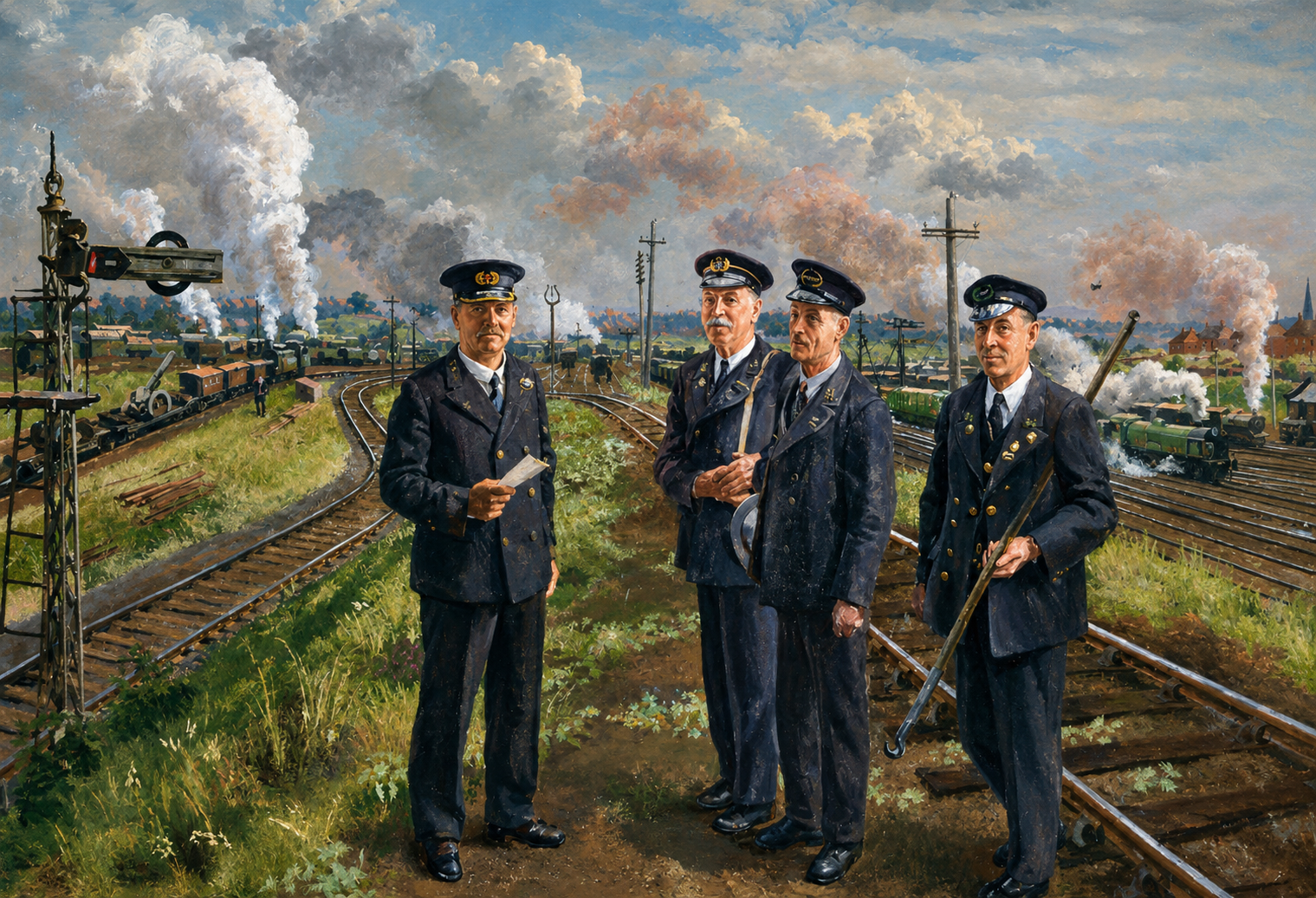
Stephen Bone; Railway Men, 1942; Rugby Art Gallery and Museum Art Collections
Introduction and Historical Context
The railway network experienced rapid and immense growth from the 1830s, reaching a near-completion of the network by the 1860s. For the first time, the general public had a convenient means of traveling across the country, providing them with the opportunity to visit distant towns and seaside resorts. The rail network also played a critical role in providing an efficient means of transporting freight over large distances.
This rapid expansion led to the creation of hundreds of railway companies each competing for passengers and freight, which proved unsustainable. The Railways Act of 1921, also known as ‘The Grouping Act, restructured over 100 companies in 1923 into what became known as the ‘Big Four’ comprised of:
- Southern Railway (SR)
- Great Western Railway (GWR)
- London, Midland & Scottish Railway (LMS)
- London and North Eastern Railway (LNER)
If your ancestor worked on the railways after 1923, it is likely they were employed by one of these four companies. You can find maps, such as the Grouping System Railway Map of the British Isles 1923 which can help identify the railway company that operated in a specific region.
Accessing Railway Worker Records
The records from the ‘Big Four’ and their pre-1923 predecessor companies were eventually transferred to The National Archives (TNA), after first being held by the British Transport Commission. Nationalisation took place in 1947 with the creation of British Railways later renamed British Rail in the 1960s. The National Archives does not hold the records of railway companies post-1948 nationalisation which means you will need to contact the individual railway companies
Many of the staff records held The National Archives are not indexed and are arranged by individual company, so knowing which company your ancestor worked for and their role is essential. Occupations in the railway industry varied widely and included maintenance workers, signalmen, station porters, ticket office staff, luggage attendants, hotel workers, and more. Women were also employed, mostly in catering and clerical roles.
The National Railway Museum could help identify the company your ancestor worked for and rail maps will show which companies operated in a particular area or region. The Railway Clearing House maps offer detailed information on the regions operated by each company and are the best resource for narrowing down your search.
Types of Records Available
The types of records most useful for family history research include:
- Staff registers
- Salary/pay registers
- Personnel records
- Apprenticeship records
- Pension records
- Company minute books
- Accident and sickness reports
- Staff magazines and railway journals
Research Tips
- Determine your ancestor’s job title and location of employment.
- Check staff magazines for mentions of promotions, retirements, etc.
- Consult railway atlases and maps to identify operating companies in specific areas.
- For pre-1923 research, you may need to check records of multiple smaller railway companies.
Additional Resources
The following GenGuide sources could assist in researching railway worker records:
- Apprenticeship Agreements, Trade
- Apprenticeship Indentures, Parish
- Directories, Trade, Professional, Telephone & Street
- Friendly & Fraternal Society Records
- Great Western Railway Shareholders Index
- Occupational and Labour Records
- Trade Union Records
Where Found
- Series RAIL, Records of the pre-nationalisation railway companies, pre-nationalisation canal and related companies, the London Passenger Transport Board, and successors. The series includes the records of the ‘Big Four’ group of railway companies, the pre-1923 railway companies and the British Transport Commission / British Railways Board as well as staff records, minute books, maps, photos, company / staff magazines etc. Named individuals of railway staff and their families can be found in series RAIL 1166 amongst the records of the Railway Benevolent Institution, 1858-1982.
- Series RAIL 1053, Summaries of accident reports, 1840-1975. Search within or browse this series to find specific records of interest.
- Series RAIL 529, North London Railway Company staff records, 1845-1922. Search for names within or browse this series to find specific records of interest.
- Series RAIL 264, Great Western Railway Company: Staff Records, 1835-1962. Search for employment details of 5000 clerks within or browse this series to find specific records of interest.
- Series RAIL 1032, Maps, Plans & Surveys: Railway Clearing House, 1870-1960.
- Series AN, Records created or inherited by the British Transport Commission, the British Railways Board, and related bodies.
- Series ZLIB and ZPER, Publications formerly held by the British Transport Historical Records Office library.
Library of Birmingham
Travel and Transport Collections. Rail related collections and resources include:
- Birmingham Railway Heritage Study Centre. The centre holds an estimated 2000 books on railways which can be borrowed. In addition, the Library of Birmingham keeps back runs of periodicals, photographs, postcards, tickets, maps and plans, and a collection of 5000 books.
- Great Western Railway Collection. Discover items such as books, magazine titles, photographs, plans, timetables and assorted ephemera mainly relating to The Great Western Railway. Notable periodical titles include a complete set of the Great Western Railway Magazine.
- Metro-Cammell Collection. The collection comprises of over 100,000 railway rolling stock drawings, rolling stock specifications, catalogues and pamphlets. The records date from c1850 to c1950.
National Railway Museum
The collection includes over 1,000,000 objects from over 300 years of railway history. The Library And Archive Centre holds drawings and papers from railway works and companies, records of individuals and families, company histories, timetables, books, magazines including staff magazines, accident reports, photographs and postcards and WWI Rolls of Honour. Search the online catalogues to explore the archive material and library resources.
London Transport Museum
London Transport Museum. The museum holds over 500,000 items that reflect all aspects of the history of public transport in London from 1800 to the present day including vehicles, signs, photographs, posters, maps, drawings, uniforms and architectural material. The Museum Library holds 15,000 books, journals and special collections covering public transport in London. The Museum holds a series of staff magazines dating back to 1913 which may name individual employees. For more information see the guide Family History at LTM. Use the collections catalogue filters to search the photographic and poster collection or search for a person or place.
STEAM
Museum of the Great Western Railway. The museum tells the story of the men and women who built, operated and travelled on the Great Western Railway. The Library and Archive includes reference books, documents and ephemera, periodicals, postcards, photographs and plans. The Steam Picture Library offers photos and artworks from the archives.
Modern Records Centre
The centre is the main British repository for national archives of trade union records.
National Records of Scotland
The archives holds the largest written and pictorial archive of Scottish railway history. The bulk of the collection is made up of the records formerly held by the British Transport Records Historical Records Department in Edinburgh.
University of Aberdeen Library
The O’Dell Transport Collection. The collection includes include: an unbroken run of Bradshaw’s Railway Manual, 1858-1923; a full run of the Railway Magazine from 1897 onwards; plans and maps of Scottish railway routes; newspaper cuttings, magazine articles, pamphlets and ephemera relating to other British and foreign railways.
LSE Library
British Library of Political & Economic Science. The Library holds thousands of pamphlets on the history of the railways in Britain and the United States. These include company reports, maps and timetables.
County Record Offices
Discover local material and collections specific to their region such as Staff Registers and Employment Records, Station Records, Timetables, Plans and Drawings, Photographs and Images, Local Accident Records and Records of Small Railway Companies.
Public Record Office of Northern Ireland
Northern Irish railway staff records.
Period Covered
1830 – Onwards
Genealogical Value
- Employee’ name, position, date of birth, addresses, place of work.
- References to the person’s character.
- Rates of pay.
- Reasons for dismissal or resignation and career details including promotions and transfers.
Further References
- Bradley, Simon. The Railways: Nation, Network and People: Profile Books, 2015
- Bradshaw’s Railway Map Great Britain and Ireland 1852: Mapseeker Publishing, 2013
- Bryan, Tim. The Great Western Railway: Shire, 2010
- Cobb, Colonel Michael H. The Railways of Great Britain: A Historical Atlas: Patrick S Cobb, 2015
- Coleman, Terry. The Railway Navvies: A History of the Men Who Made the Railways: Pimlico, 2000
- Conolly, W. Philip. British Rail Pre-Grouping Atlas and Gazetteer: Ian Allan Publishing, 1997
- Dewick, Tony. Complete Atlas of Railway Station Names: Ian Allan Publishing, 2002
- Dewick, Tony. Rail Atlas 1890: Ian Allan Publishing, 2005
- Drummond, Di. Tracing Your Railway Ancestors: A Guide For Family Historians: Pen and Sword Books, 2010
- Edwards, Cliff. Railway Records: A Guide to Sources: PRO Publications, 2001
- Emmerson, Andrew. The London Underground: Shire, 2013
- Gittins, Sandra. The Great Western Railway in the First World War: The History Press, 2010
- Guy, Andy & Rees, Jim. Early Railways: Shire, 2011
- Handbook for Railway Steam Locomotive Enginemen: Ian Allan Publishing, 2014
- Hardy, Frank. My Ancestor was a Railway Worker: Society of Genealogists, 2009
- Hardy, R. H. N. The Railwayman’s Pocket Book: Conway, 2011
- Hawkings, David. Railway Ancestors: A Guide to the Staff Records of the Railway Companies of England and Wales 1822-1947: The History Press, 2008
- Maggs, Colin G. Train Driver’s Manual 1900: Amberley Publishing, 2014
- May, Trevor. The Victorian Railway Worker. Shire Publications, 2003
- Railway Clearing House Atlas of England and Wales, 1904: Ian Allan Publishing, 2001
- Railway Traveller’s Handy Book 1862: Hints, Suggestions and Advice for the Anxious Victorian Traveller: Old House Books, 2012
- Richards, Tom. Was Your Grandfather a Railwayman? A Directory of Railway Archive Sources for Family Historians: FFHS, 2002
- Roden, Andrew. Great Western Railway: A History: Aurum Press, 2012
- Smith, Paul & Turner, Keith. Railway Atlas of Ireland Then & Now: Ian Allan Publishing, 2014
- Wolmar, Christian. The Subterranean Railway: How the London Underground Was Built and How it Changed the City Forever: Allen & Unwin, 2012
TNA Research Guides:
Railways
Railway workers: further research
Websites
The National Archives Research Guide
How to look for records of Railway workers. Use this guide if you are searching for records of people who worked for railway companies in the UK before the railways were nationalised in 1947.
The National Archives Research Guide
How to look for records of Railway employment records 1833-1956.
The National Archives Research Guide
How to look for records of Railways. Use this guide if you are looking for records of railways.
The National Archives
All change!’ on Britain’s railways. Railways have brought, and continue to bring, great changes to peoples’ lives. Since the 19th century they have changed the environment, standardised time and revolutionised holiday habits. Explore 20 key dates in the history of railways.
National Records of Scotland
Research Guide: Railway Records. National Records of Scotland holds the largest written and pictorial archive of Scottish railway history.
The Network Rail Archive
Explore the archives online and learn more about railway records to help with your research. Find out about how the railway was built, the great engineers and visionaries involved. The Corporate Archive manages and preserves a large collection of historical railway engineering drawings, as well as a modern business archive.
Railway 200
The Railway 200 website provides information and resources related to British railway history, particularly focusing on the period from 1800 to 2000. The site hosts an extensive collection of historical photographs and diagrams depicting trains, stations, and railway infrastructure as well as primary sources including timetables, maps, and official documents.
National Transport Trust
Rail Heritage Survey
Rail Map Online
The site provides interactive maps of historic railways, canals, airfields and trolleybus routes for the UK, Ireland and US.
Midland Railway Society
The society is for those interested in the Midland Railway; its predecessors, successors, joint lines and working arrangements. They help run the Midland Railway Study Centre which houses the largest publicly accessible collection of Midland Railway ephemera and documentation. They also publish books and pamphlets on historical aspects of the Midland Railway.
The Railways Archive
The site hosts an archive of UK railways documents including scanned images of original documents relating to the development of the industry and rail policy. Of particular interest to family historians are the accident reports and publicity material.
Warwickshire Railways
This site is created for the railway enthusiast, local historian and railway modeller by fellow enthusiasts. It is dedicated to the research, study and recording of the history of Warwickshire’s railways from 1837 to circa 1970. He site includes an introduction and background to the rail routes and companies operating in the area and a list of stations, junctions, goods depots.
The Great Western Archive
The site includes a history of the Great Western and a biographies of GWR Chairmen as well as a selection of Great Western Stations with histories, track plans and signalbox diagrams.
Grace’s Guide
The Guide is the leading source of historical information on industry and manufacturing in Britain. The aim is to provide a brief history of the companies, products and people who were instrumental in industry The site includes a section on Railway Companies, Railway Equipment and Workshops.
The Lancashire and Yorkshire Railway Society
The Society is dedicated to preserving and sharing the history of the Lancashire and Yorkshire Railway. The site has a system map showing L&Y’s routes and their connections to other company’s lines.
Great Eastern Railway Society
The Society is dedicated to the former Great Eastern Railway, its predecessors and its successors and has a useful a section on Genealogy for people researching their family history.
London and North Western Railway Society.
The society is dedicated to the study and preservation of the history of the London and North Western Railway which was one of the largest and most important railway companies in the United Kingdom before the 1923 grouping. The site hosts an archive of documents, photographs, and other materials such as staff circulars, WW1 Roll of Honour, staff records, photos and a staff history.
Science Museum Group
Explore over 380,000 objects and archives from the Science Museum, Science and Industry Museum, National Science and Media Museum, National Railway Museum and Locomotion. Digital archive material is available covering the following themes: The development of railways from goods transport to commuter travel; Posters and handbills; Passenger comforts; Railway photographic collection; Infrastructure.
Irish Railway Record Society
The society is dedicated to recording and preserving Ireland’s railway heritage and has a library and archive dealing with all aspects of the Irish Railway including books, pamphlets, current and non-current periodicals. Special collections include timetables and associated literature, Irish transport reference books and Irish Transport Periodicals.
Railway Museum
How to trace your railway ancestor.
Railway Museum
Researching a family connection to the railways? Discover a range of resources and information to help you on your search. Follow the tips and suggestions in the steps below to delve deeper into your ancestors’ railway stories and find out what their working life was like.
Railway and Canal Historical Society
the Society is dedicated to the study and preservation of transport history with a focus on railways and canals. The site has an extensive research section for those researching family history or railways history.
Hopetown Darlington
The museum is home to a vast collection of over 30,000 objects including archives, vehicles, art, costumes, ephemera and furniture showcasing the history of the railways in Darlington and the wider North East region from 1825 up to the late 20th Century.
National Railway Museum
Caution! Railway Safety Since 1913. Discover the story of railway safety over the last 100 years, explore the attempts to prevent injuries and deaths among workers, passengers and children.
The London & North Eastern Railway
Encyclopedia. The site is an enthusiast website dedicated to providing information about the historic LNER railway company.
Pre-Grouping & Other Companies
Railway Companies in Great Britain before 1923. The site lists early British railway companies.
Urban 75:railways
Explore photos of disused stations, abandoned railways, steam trains and old buildings.
Index for Railways
Outline History of the British Railway Network. The section provides an overview of the railway system in Britain.
Index for Railways
The Railway Clearing House. In 1842 nine British railway companies set up the Railway Clearing House (RCH) to sort out the charges due when one company’s vehicles travelled on another company’s lines.
National Library of Scotland
Map Collections. Official railway map of Scotland, prepared at the Railway Clearing House, London 1923
Mike’s Railway History
The website has facts and stories about railways, trains, locomotives and the railway engineers, who built and ran them with focus on railways in 1935 and before.
Archives Hub
Railway history: 200 years of the steam locomotive. Archived catalogue descriptions of rail related material.
Transport for London
Corporate Archives. Find out what the Corporate Archives is, get started with your research, or simply browse for interesting snippets from our historic collections. The Archives collects and preserves both modern and historic records from the business and holds over one hundred thousand items dating from 1556 to the present day.
Transport for London Corporate Archives
A Journey Through Time. The collection, hosted on the Google Arts & Culture platform, features over 2,000 historical documents and images from TfL’s archives, covering London’s transport history. The collection includes over 400 digitised maps, historic documents, station designs, oral histories and other materials that illustrate the evolution of London’s transport network.
Online Databases
- UK, Railway Employment Records, 1833-1956. This database includes indexed images of employment-related records from a number of historic railway companies in England, Scotland, and Wales. Record types in the database include staff registers, station transfers, pension and accident records, apprentice records, caution books and memos. The original data is from Series Rail held at The National Archives.
- Ireland, Railway Employment Records, 1870-1940. This collection captures the lives of men and women employed by the railways of Ireland, including bus lines and tramways. The collection is provided in association with the Irish Railway Record Society.
- England, Great Western Railway Magazine, 1938-1943. This database seeks to illuminate a few of the staff employed by the Great Western Railway Company between 1938 and March 1943.
- England, Southern Railway Magazine, Jan 1840-Feb 1942. This database seeks to illuminate a few of the staff employed by several Railway Companies between 1840 – Mar 1943.
- The Railway and Commercial Gazetteer of England, Scotland and Wales 1907. Browsable edition of this book which lists ‘every railway station, town, village, hamlet, parish, and place in Great Britain’.
- Railway Gazette, 1860-1930. This database is drawn from issues of the newspaper printed between January and June of 1927 in addition to those of January to June of 1930.
- London, London Transport Staff Registers, 1863-1931. These staff records date from the opening of the earliest underground line, the Metropolitan line, in 1863, and cover underground, bus, tram and some clerical staff.
- Web: UK, Register of Railway Employee Injuries and Deaths, 1911-1915. The site has details of railway worker accidents in Britain and Ireland from the late 1880s to 1939 extracted from a variety of sources with all data obtained from the source’s website published by the National Railway Museum.
- Trade Union Membership Registers. Digitised images of original records books from 9 different trade unions from the Modern Records Centre, University of Warwick. Search for an individual in the records including admission books, annual reports and membership lists and include details about individual members such as payments made, benefits received and the names of spouses. The unions include the Amalgamated Society of Railway Servants, 1872-1913 and the Lancashire and Yorkshire Railway Company, 1872-1928.
- Derbyshire, Derby Railway Servants’ Orphanage Registers, 1875-1912. The Derby Railway Servants’ Orphanage opened in 1875. The home came about in response to the hundreds of railway employees who died each year in the course of their work.
- Wiltshire Great Western Railway Hospital Records, 1883-1916. This collection includes the records for many Great Western Railway workers who sought treatment at the company’s hospital.
- Barry Railway Company Accident Registers 1889-1917.
- Barry Railway Company Staff Registers 1888-1896.
Cheshire Archives and Local Studies
Railways Staff Database, 1869-1950. Search 17 staff registers of four former railway companies including:
- Cambrian Railway
- Great Western Railway
- London and North Western Railway
- London and North Western and Great Western Joint Railway
- Crewe railway works, c1890-1928. Records of employees at Crewe railway works.
West Sussex Record Office
Southern England Railway Employee Cards, 1873-1986. The collection comprises of 50,000 personnel cards of all employees in its Southern Region, plus the predecessor companies including British Railways, 1948-1965 and British Rail, 1965-1996. Search by name or browse the collection by typing SEREC in the online catalogue.
The Genealogist
Railway Employment Records. Indexes of Railway Employment including records taken from Railway Company Staff magazines.
Society of Genealogists
SoG Data Online. Datasets include:
- Index to London and North Eastern Railway / British Rail Staff Cards, 1923-1960’s.
- Index of names extracted from The Great Western Railway in the First World War by Sandra Gittins.
- Name index to Railwaywomen extracted from the book “Railwaywomen” by Helena Wojtczak.
- The Railway year book 1907
Railway Work, Life & Death
The project provides a comprehensive database documenting railway worker accidents in Britain and Ireland from the late 1880s up to the start of the Second World War (1939). The database contains detailed records about who was involved in accidents, what roles they had, what happened and why. It draws from official Railway Inspectorate accident reports, railway company benevolent fund records and trade union documents. The project is a collaboration between the University of Portsmouth, the National Railway Museum and the Modern Records Centre at the University of Warwick.
Old Scottish
Workmen’s Compensation Act records. Search records of compensation paid in the event of accident or injury at work. The Workmen’s Compensation Act 1897 applied to industrial workers in railways, factories, docks, mines, quarries, engineering works and building or demolition.
Historic England Archive
London Midland and Scottish Railway Collection. Dating from the 1880s through to the 1930s, the photographs were taken for advertising and marketing purposes by both the LMS and its constituent companies covering London, Derbyshire, Gloucestershire, Yorkshire, Wirral, Bristol, Herefordshire, Shropshire, Somerset.
Modern Records Centre
The Railway Review: Digitised Editions. Early issues of The Railway Review, “a weekly newspaper for railwaymen” produced by the Amalgamated Society of Railway Servants and its successor the National Union of Railwaymen, have been digitised to help preserve and provide wider access to the fragile volumes.
Forces War Records
UK, WWI, North Eastern Railway Roll of Honour, 1914-1919. Details of over 9,000 railway men who enlisted in the First World War.
Lancashire and Yorkshire Railway Society
Rolls of Honour: Downloadable document produced in 1915 of the names and departments of all L&Y employees then serving and those reported as lost or missing. The second document was produced at the end of the war and lists all L&Y staff who gave their lives in the conflict and those who were decorated for bravery.
London Transport Museum
Search Our Collection. Discover the story of London and its transport system over the last 200 years, capturing London’s public transport history from the 1800s to the present day. Use the catalogue filters to search the photographic and poster collection or search for a person or place. Also browse objects by collection type including vehicles, signs, maps, posters and photographs.
CD Roms
Your Old Books & Maps
British Locomotives 1894.
GenFair
CD products include: The Railway Year Book for 1922; Cornwall Railway Staff in 1889; The Railway and Commercial Gazetteer of England, Scotland and Wales 1907.
