
Nature of Source
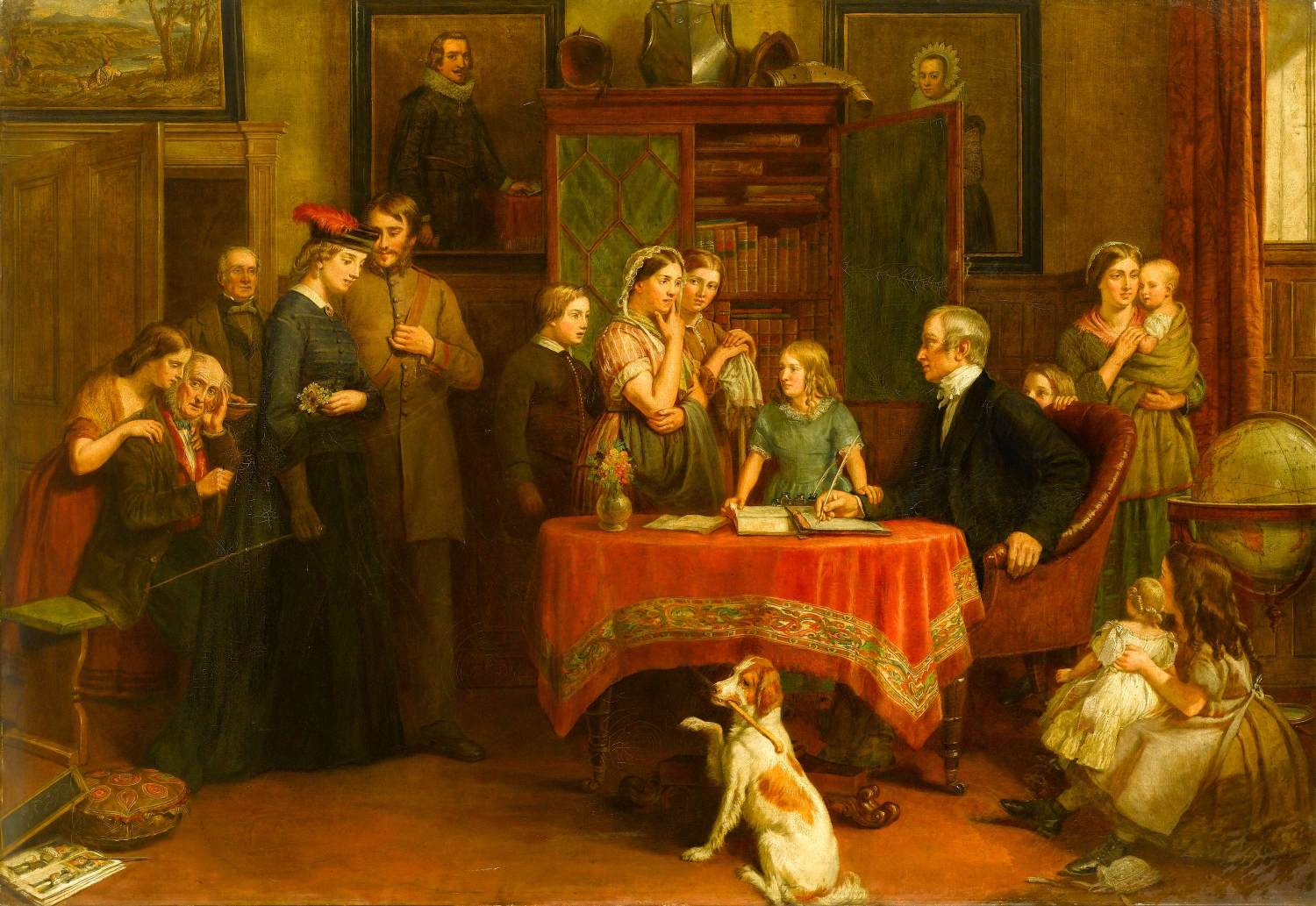
The Census of April the 8th, 1861 by Charles Landseer (1861). Image courtesy of the Web Gallery of Art
Introduction to the Census
Census records are one of the most valuable resources for genealogists and family historians. Taken every ten years, the records provide a detailed count and comprehensive snapshot of the population and offer a wealth of demographic, social, and economic information about our ancestors. The census essentially captures a record of all individuals residing in a particular location on a particular day be it a residential dwelling or an institution. The 1801-1831 census were headcounts only and were mostly destroyed. A few returns with personal data survive and are located in local archives. However, they can provide statistical summaries.
The Census Taking Process.
- Areas were divided into smaller geographical units called enumeration districts.
- An enumerator delivered a census schedule (form) to the head of each household.
- The head of the household completed the schedule giving detailed information about each member of the household whether a family member, servant, lodger or visitor.
- In the event of illiteracy, the enumerator copied down answers orally from the head of household. For the 1911 census machines were used for the first time to tabulate the results directly from the household schedules.
- The enumerator collected the completed schedules and then transcribed the information from these returns into enumerator books. The original returns were destroyed by the authorities after transcription.
- The completed enumerator books were submitted to the local registrar who forwarded them to the central census office in London for analysis.
Issues and Tips
- Be aware that the census returns are littered with mistakes, some intentional and some accidental. Some were made by the enumerator and some by the subject.
- Remember that prior to 1911, the information in census records is from the enumerators’ summary books which are copies made by enumerators from the original household schedules. The original schedules for the 1841-1901 censuses were almost all destroyed after the information was copied. This means census returns may contain errors or alterations made by enumerator during the copying process. The 1911 census was the first where the original household schedules were kept.
- Mistakes also arose due to widespread illiteracy, mishearing by the enumerator, illegible handwriting or the failing memory of those enumerated.
- ‘Dressmaker’ and ‘Of independent means’ were common euphemisms for women working as prostitutes. See Flower and Dean Street in Whitechapel in London as an example of a notorious rookery.
- Public access to census returns is closed for a hundred years and none was taken in 1941. The whole of the 1931 census including schedules and enumeration books were accidentally destroyed in a fire at a store at the Office of Works in Hayes in 1942.
- In some cases whole pieces of the census are missing or severely damaged. For a list of missing census returns see the findmypast article Census for England, Wales and Scotland: missing pieces. Check with local societies if damaged pieces have been transcribed. For example the Manchester & Lancashire FHS have transcribed ‘lost’ parts of the 1851 census. See www.1851-unfilmed.org.uk/intro.htm for more information. These ‘lost’ returns are available to search online at www.ancestry.co.uk.
- Also look for one-off local census and population lists. These censuses were often taken for taxation, charitable or religious reasons. Consult two books, one by Gibson & Medlycott and the other by Chapman (see below) for more details of locating these sources.
- A single forward slash in the books indicates the end of a household whilst a double forward slash indicates the end of a building.
- When looking at a census form remember that the year is rarely shown on the page and the schedule number is not the house number.
- Ages were often struck through by the census collector checking off entries.
- Always search surrounding streets for other family members. If a child’s birthplace (especially the eldest) is shown different from that of the parents or of the census place, it could indicate that the mother had returned to her family’s home for the first birth. This could be a vital clue showing her childhood address.
Online Searching Tips and Missing people
First names may have been recorded in their diminutive form and some enumerators themselves abbreviated names such as Jas for James. Also be aware that transcriptions and indexes can have numerous errors so try a variety of search strategies and try different providers.
When searching online census transcriptions, remember that the vast majority of the population were recorded in the censuses. Use a variety of search strategies and providers if an individual is proving difficult to track down. Some people were away from home on census night working away from home, visiting friends or staying at a hotel and are collectively known as ‘Census Strays’. Others may have been a patient in a hospital or an asylum or other institutions such as workhouses or prisons. All these institutions were enumerated but unfortunately it was common practice to enumerate an inmate only by their initial plus surname. Locating a prison inmate on the census is even more challenging as the authorities only recorded the person’s initials between 1841 and 1861. However, the returns do state the prisoner’s condition, age, occupation and where born. A child missing from a census could have been be staying with relatives on census night or possibly living on a permanent basis with them.
Others might have been residing in a workhouse or orphanage. However it is possible that the person being searched was not at any dwelling on census night or was simply not enumerated or even changed their name. Some people may not be where expected as they were visiting another area. It is also possible that the person was away from the country especially as overseas travel became increasingly affordable in the 19th century.
A person missing from the census might have been serving abroad in the armed services. No returns were made for the armed forces in the 1841 and 1851 censuses. From 1861 the census recorded Royal Navy officer and crew at sea on special forms, although returns were made for 1841 and 1851 but have been lost. Census crew lists for 1861, 1871 and 1901 are available at the The Genealogist. The Census crew lists contain data about Naval personnel both foreign and abroad, as well as information on the crews of non-naval vessels in UK ports. The 1911 census enumerated all servicemen and women serving in the arm or navy whether stationed here or abroad. For an index of Index to Royal Navy ships that were at sea or in ports abroad on the night of the 1901 census see here. Merchant Navy seamen were recorded only if in port from 1851 with the system of enumeration undergoing a number of revisions over the years. For more detailed information on the Merchant Navy see here, here and here.
Addresses
In towns few houses were numbered until the end of the 19th century and many streets were renumbered or renamed. Only the online 1881, 1901, 1911 and 1921 censuses can be searched by address. The Historical Streets Project provides online access at The National Archive’s Your Archives to street indexes for the 1841, 1851, 1861, 1871 and 1891 census. The streets are listed in alphabetical order for each registration district and give the full National Archives reference.
1911 and 1921 Censuses
The 1911 census consists of the original household schedules which were completed and signed by the head of household, in previous census years the enumerator copied the information from the schedules into enumerator’s books. Only a small space was left on the schedule for the address details which were completed by the householder. In addition to the householder schedules, the enumerators’ summary books provide a detailed description of each district and other statistics and were compiled by the enumerator from information supplied on the household schedules and are available at Findmypast and at Ancestry. For a guide to the 1911 census references see here. It is estimated that several thousand Suffrage supporters boycotted the 1911 census. Again for the 1921 census, the household schedules were completed and signed by the head of household having been distributed by the enumerators. For the 1921 census, boarders residing at an address and receiving their meals each day are considered a part of the household and therefore appear within the household group. A lodger receiving bed only is dealt with as a separate household and is recorded on a separate schedule despite residing at the same address. Unfortunately the 1921 Enumerator Books were destroyed by fire.
For those missing from census returns or unable to find, see other population listings including:
Directories, Trade, Professional, Telephone & Street
Electoral Registers or Burgess Rolls
Rate Books
Return of Owners of Land, 1873
Tithe Award Records/Apportionments
Valuation Office Field Books & Maps
For pre-census population listings see:
Fire Insurance Registers, Plans and Maps
Hearth Tax, 1662-1689
Hundred Rolls, 1279
Lay Subsidy Rolls, 1275-1665 (including the Great Subsidy of 1524/25)
Muster Rolls, 1285-1642
Poll Tax Returns, 1377-1698
Protestation Oath Rolls, 1641-1642
Rate Books
Where Found
- Series HO 107, Home Office: Census Returns, June 6 1841.
- Series HO 107, Home Office: Census Returns March 30 1851.
- Series RG 9, General Register Office: Census Returns, April 7 1861.
- Series RG 10, General Register Office: Census Returns, 02 April 1871.
- Series RG 11, General Register Office: Census Returns, 03 April 1881.
- Series RG 12, General Register Office: Census Returns, 05 April 1891.
- Series RG 13, General Register Office: Census Returns, 31 March 1901.
- Series RG 14, General Register Office: Census Schedules, 31 December 1911.
- Series RG 15, General Register Office: Census Schedules, 19 June 1921.
Visitors to The National Archives in Kew can view the 1921 Census online for free, via the Findmypast website, as will visitors to two regional hubs at Manchester Central Library and the National Library of Wales
The National Archives
- Series RG18, Office of Population and Censuses and Surveys: General Register Office: Reference Maps of Registrar’s Districts. The series consists of printed maps with manuscript additions, mainly showing registration districts and sub-districts in England and Wales, at the time of the population censuses of 1861 (London only), 1871 (except London), 1891 and 1921.
Society of Genealogists
Copies and indexes covering a number of censuses. The society also has a large collection of census films available for use in its library.
County Record Offices
Holdings include local census returns and transcriptions.
Family History Societies
Local census returns and transcriptions.
Period Covered
1841 – 1911
Genealogical Value
- Place of residence including parish and village. From 1851, name of street, road, house number or name is stated. From 1891, number of rooms occupied if less than five.
- First name, middle name (often only initials) and surname.
- Relationship to the head of household, usually the oldest male (not available in the 1841 census).
- Marital status/Condition, showing whether married, single, widowed or widower. From 1891 the letter ‘S’ replaced the abbreviation ‘Unm’, ‘Un’ or ‘U’ for unmarried. (no marital status shown for the 1841 census).
- Age, at last birthday. For the 1841 census, ages over 15 were rounded down to the nearest 5 years with the actual age given for those under fifteen).
- Gender, male or female
- Occupation, profession or trade for all census years. For 1841, the option of ‘of independent means’ included. ‘Rank’ included for 1841 to 1881 returns. For 1891, ‘Employer, employed or neither’ included. For 1901, ‘Employer, worker or own account or if working from home’ included. Please note the Genealogist has indexed occupations across all available census returns.
- County and parish of birth, name of county and often the town. For the 1841 census, a simple Yes or No only is recorded if born in the same county.
- Country of birth, name of country if born outside of England. For the 1841 census, only an ‘S’ for England, an ‘I’ for Ireland and an ‘F’ for foreign parts is recorded.
- Disabilities, mental or physical (not available in the 1841 census): The 1851 and 1861 censuses shows whether blind or deaf and dumb; The 1871 and 1881 and 1891 add whether imbecile, idiot or lunatic; The 1901 and 1911 as previous with feeble-minded substituted for idiot.
The authorities classified a lunatic as a person suffering from mental illness. A person categorised as an imbecile had developed dementia in later life. An idiot suffered from mental deficiency from birth. - Total of houses on page.
- Total of males and females on page.
1911 Census
Additional fields included in the 1911 census include:
- Number of years married.
- Total number of children born alive to the marriage.
- Number of children still living and number who have died.
- Industry employed in.
- Nationality of those born abroad.
1921 Census
Additional fields included in the 1921 census include:
- For marriages a ‘D’ is recorded if marriage dissolved by divorce.
- For children under fifteen, parents are shown as both alive or both dead, father dead or mother dead.
- If in full or part-time education.
- Name and type of business as well as address of present employer or last employer for those ‘out of work’.
- Place of birth and nationality for those born outside the UK and whether a visitor or resident.
- If born at sea.
- Royal Air Force service men and women included for the first time including those stationed overseas.
- Please note the additional fields in the 1911 census covering the number of years married, the total number of children born alive to the marriage and the number of children still living and number who have died are NOT included in the 1921 census.
Further References
- Annal, David. Easy Family History: The Stress-Free Guide to Starting Your Research: Bloomsbury, 2012
- Chapman, Colin. Pre-1841 Censuses & Population Listings in the British Isles: Lochin Publishing, 2002 (Preview available from Google Books)
- Christian, Peter & Annal, David. Census: The Family Historian’s Guide: Bloomsbury, 2014
- Gibson, Jeremy and Hampson, Elizabeth. Marriage, Census and Other Indexes for Family Historians: FFHS, 2000
- Gibson, Jeremy and Medlycott, Mervyn. Local Census Listings 1522-1930: FFHS, 2001
- Hanson, John. How To Get the Best from the 1911 Census: SoG, 2009
- Higgs, Edward. Making Sense of the Census Revisited: Institute of Historical Research, 2005
- Higgs, Edward. A Clearer Sense of the Census: HMSO, 1996
- Higgs, Edward. Life, Death and Statistics: Civil Registration, Censuses and the Work of the General Register Office, 1836–1952: Local Population Studies, 2004
- Hutchinson, Roger. The Butcher, the Baker, the Candlestick-Maker: The Story of Britain Through its Census, Since 1801: Little, Brown Book Group, 2017
- Jolly, Emma. A Guide to Tracing Your Family History using the Census: Pen & Sword Books, 2020
- Lawton, Richard. Census and Social Structure: An Interpretative Guide to Nineteenth Century Censuses for England and Wales: Routledge, 1978
- Lumas, Susan. Making Use of the Census: PRO Publications, 2002
- McLaughlin, Eve. The Victorian Censuses: Use and Interpretation: Varneys Press, 2001
- McLaughlin, Eve. The 1901 Census and How to Tackle It: Varneys Press, 2002
- Raymond, Stuart, A. Census: 1801-1911 A Guide for the Internet Era: Family History Partnership: 2009
- Riggs, Geoff, Distribution of Surnames in the 1881 British Census, London: Guild of One-Name Studies, 2001
- Smith, Simon. The British Census: Shire Publications, 2021
The EurekA Partnership: Various titles containing transcriptions of Pre-1841 Census returns covering Bedfordshire, Berkshire, Buckinghamshire, Gloucestershire, Northamptonshire, Oxfordshire, Surrey, Warwickshire and Worcestershire
Websites
Guides to the Census
The National Archives Research Guide
How to look for records of Census records. This guide explains how to access the historical censuses from 1841 to 1921 and provides information on using the census returns.
Society of Genealogists Guide
How to use Census records
Prison History
How to use the Census for Prisons Research. How to use the Census effectively for prison research including prisoners and staff.
Ancestry Solutions
Census Quick Reference Charts
Family Tree
How to find your UK ancestors on the census
Family Tree
How to use census records for family tree research
Family Tree
Why can’t I find my ancestor on the census?
Findmypast
Expert advice 1911 Census
Findmypast Blog
Here’s what it was like to take a national census back in 1921. From organising the enumerators to producing the reports. Stephen Rigden explains how it was done and why it’s so important.
Free UK Genealogy
The site offers a practical and straightforward beginner’s guide explaining why censuses matter, what information they contain and how to search them. The article illustrates how census records reveal changing family circumstances over time using a worked example. It focuses on England/Wales but notes differences for Scotland and Ireland.
The National Archives Blog
Missing from the census? Reasons that explain why you might not find somebody in the census.
FamilySearch Wiki
England Census: Further Information and Description
Jayne Shrimpton
The 1921 Census & Family Photographs. The article examines the form and content of family photographs and explains how to date and identify 1921 census-era photographs.
Who Do You Think You Are? Magazine
What UK census records are available?
Who Do You Think You Are? Magazine
When was the 1901 census taken?
A Vision of Britain through Time
Census Reports. The site brings together historical surveys of Britain to create a record of how the country and its localities have changed. The site has a listing of reports into each years census including statistical analysis of surnames and occupations as well as guides to using the census and its history.
GENUKI
United Kingdom and Ireland Census. General information and links related to the census.
Office for National Statistics
Census history. The site covers the origins of the census in the ancient world and describes the history of its development to the present day.
Guy Etchells
The instructions given to the enumerators covering the 1841-1901 censuses.
Family Tree
Seven reasons you can’t find your ancestor on the census. Locate missing ancestors on the census for Scotland with our seven-point checklist.
FreeBMD
Guidance on reading Victorian handwriting
Roads and Streets
Gendocs
Victorian London A-Z Street Index from Gendocs, archived copy
The Underground Map
Creating Street Histories. The site creates street histories for the areas of London and surrounding counties lying within the M25. The aim of the project is to find the location every street in London, whether past or present. You are able to see each street on a present-day map and also spot its location on older maps.
Tr4ce Genealogy
Victorian London A-Z Street Index
thehunthouse
Old Maps and Books. Resources include: Two lists of London Street name changes that occurred between 1857-1929 and between 1929-1945, also available as an eBook; A finding aid for London Postal Districts by name and number with a current map; A list and map of the Metropolitan Boroughs used in the street name list; A list of every street in London in 1938
Pub Wiki
The story behind our pubs in the UK. Pub History in London, Suburbs and the South, mainly 1600 to 1940. The site offers transcribed entries of trade directories some with original images as well as London street indexes and listings and links to online and downloadable street directories.
Internet Archive
London County Council. Names of Streets and Places in the Administrative County of London: Including the Names of Blocks of Dwellings, Parks, and Open Spaces: London County Council, 1901.
Cassini Publishing
The National Archive Registration District Historical Maps. Online digital versions of the original Registration District maps from the 1871 census. This set of maps is the only known collection of this type in the world.
The Lost London Street Index
Index of London Streets. Street name changes and those that are no longer in existence or shown on maps.
London Census 1891 Transcription
The Streets of London 1891. The site has a complete listing of the Streets of London in 1891.
Occupation and Employment and Names
Family Tree Researcher
Dictionary of Old Occupations: A-Z Index
Olive Tree Genealogy
Obsolete Occupations in Genealogy
London Census 1891 Transcription
Victorian Occupations. A collection of the occupations or job descriptions of the people living in London in the 1890s.
London Census 1891 Transcription
Common Surnames in 1891. The site offers lists extracted from the 1891 census of Common surnames in 1891; Popular male first names in 1891 and popular female first names in 1891.
Online Historical Population Reports
Histpop. University of Essex. The collection provides online access to the complete British population reports for Britain and Ireland from 1801 to 1937 including official reports, legislation and essays on the censuses including statistical analysis. The documents on the site include indexes to parishes, townships and places used in the official reports.
Findmypast
1911 census occupation codes.
Peter Christian
A Dictionary of Occupational Terms Based on the Classification of Occupations used in the Census of Population, 1921. For each of the terms in this classification, the dictionary provides a description of what that occupation involved.
Census Abbreviations
GENUKI
Abbreviations used on Census Transcripts
FamilyHistory
Census Abbreviations. Summary of UK census abbreviations covering occupations, names and places, houses, relationship to head and condition
Family History UK
Abbreviations Used On Census Returns
London Census 1891 Transcription
Census Abbreviations
Web of English History
Occupations: census returns for 1851, 1861 and 1871
Census Forms
CensusTools
Genealogy Spreadsheets. Record, preserve and archive family history research data.
Ancestry
UK Census Forms
Whereabouts of Transcriptions
Census Online
Links to online census records for England.
CyndisList
Links to online census records.
Parish Chest
Census. Links to companies and organisations selling local census transcriptions.
Steve Morse
One-Step Webpages. Search 1841-1911 census sites with ‘one step’ search forms.
Online Databases
National Coverage
Findmypast
Census transcriptions and images, 1841-1921. Features include an address and property search across all British censuses from 1841 to 1921 with enhanced features like name variants and radius settings. The 1921 census is only be available via pay-per-view access for an initial period. A dedicated address search is also available for the 1921 census. For Welsh census returns, Findmypast provides translation tables to translate the most common terms into English if the census form you need was completed in Welsh. Pre-1841 census returns include: Shrewsbury St Julian’s Parish, 1831 Census; 1801 &1821 Kent, Dartford Census; Corfe Castle and District 1790 Census; Nether Hallam, Sheffield 1831 Census.
Findmypast
1921 Census Of England & Wales Official Reports. Explore this unique collection of official census reports including county reports, the full 1921 Census national report as well as the Dictionary of Occupational Terms.
Findmypast
Wiltshire Census Lists 1650-1887.
Ancestry
Census transcriptions and images, 1841-1921. Census transcriptions with digitised images. Features include a first name or surname search facility. The 1911 collection consists only of the Enumerator Summary Books and also links to the UK Maps, 1896–1904 supplied by Cassini Historical Maps which means you can link to a map revealing the area they lived in.
MyHeritage
The collection provides census images and transcriptions from 1841 to 1901 for England, Wales, the Channel Islands, and the Isle of Man.
The Genealogist
Census transcriptions and images, 1841-1911. Features include a name or keyword search facility, ‘profession field’ search and other enhanced searches. The Genealogist has indexed occupations across all available census returns. The 1881, 1891, 1901 and 1911 census returns are linked to historic Ordnance Survey maps through the Map Explorer feature which allows users to easily identify the locations of houses, streets and parishes plotted on georeferenced historic and modern map layers.
Roots UK
Census transcriptions and images, 1841-1901.
Genes Reunited
Census transcriptions and images, 1841-1911. The 1911 census includes a mapping tool to allow users to map where their ancestors were at the time it was taken.
FamilySearch
Free access to indexes and transcriptions for the 1881 census but with no original images. Also free searches of the 1841, 1851, 1861, 1891 and 1901 censuses with an option to view original images at the fee based Findmypast.
FreeCEN
Census transcriptions, 1841-1911. The site provides free access to census transcriptions covering England, Wales and Scotland including occupation transcriptions. Check the site to see a listing of counties by census year with the number of records online for each. Then select Details to see which pieces/places are online for that county. Included are Royal Navy ships and Scottish shipping.
UK Census Online
Census transcriptions, 1841-1921. Free searches but pay to view full record. Operated by S & N Genealogy Supplies
FHS Online
Family History Societies Online. Census transcriptions 1851 and 1862. Transcriptions covering England and Wales. The census material is free to search once registered.
Brigham Young University
Early British and Irish Census Project. The database covers British and Irish census records from 1801 to 1840. The project brings the numerous pre-1841 English, Irish, Scottish, and Welsh census records into one searchable database.
FamilySearch
FamilySearch Explore Historical Images. Search groups of images in the world’s largest collection of historical documents. Type in a place-name such as a city, state, county or country and explore relevant record collections such as census returns and parish registers of baptism, marriage and burial
Regional and Other
Durham Records Online
1841 census transcriptions for all of County Durham; 1851 through 1891 census transcriptions for many County Durham communities, plus 1901 for Easington district.
London Census 1891
London Census 1891 Transcription. The site offers searchable and browsable transcribed names and full details of the people living in London in 1891 listed by street and house
Findmypast
London, Westminster Marylebone Census 1821 & 1831. The dataset contains over 22,000 census results covering Marylebone in the City of Westminster. Every record consists of a transcript and an image of the original document.
Findmypast
Nether Hallam, Sheffield 1831 Census
Findmypast
1801 and 1821 Kent, Dartford Census
Findmypast
1801 Lancashire, Liverpool Census. Search over 13,000 early census records covering 82 Wards in Liverpool
GENUKI
Pre-1841 Devon Censuses and Population Listings.
Wirksworth Website
Transcribed data covering 40 square miles around Wirksworth and Matlock, Derbyshire. Data sets include Parish Records 1600-1900, Derbyshire Wills 1525-1928, census returns, Petty sessions, Memorial Inscriptions, Board of Guardians, Hearth Tax and others.
The Weald
The Weald of Kent, Surrey and Sussex: Lists of named individuals extracted from sources including census returns and directories from towns and villages in the region as well as maps, pictures, books and documents
UKBMD
The volunteer led site provides links to websites that offer on-line transcriptions of GRO and local births, marriages and deaths indexes as well as censuses returns.
CD Roms
Local Family History Societies
(Local census returns and transcriptions.
GenFair
Browse tens of thousands of family history products including census returns from hundreds of suppliers. The largest range of products covering the British Isles and overseas. Resources include the Royal Navy at Sea & Ports Abroad, 1861, 1871, 1901 census returns. Check site for full coverage.
S & N Genealogy Supplies
Various census sets covering English and Welsh counties including the 1861 & 1871 Royal and Merchant Navy returns.
Your Old Books & Maps
Census Classification of Occupations, 1931. A ‘must have’ aid for deciphering occupations on those hard to read census returns. Occupations rarely change and this CD will be invaluable for 1901 & 1911 census returns.
Stepping Stones
Specialist publisher of census data on CD.
British Data Archive
Publisher of census data on CD for every county in England and Wales for 1841, 1851, 1861, 1871, 1891, 1901 as well as selected counties for 1881.
Parish Chest
Links to companies and organisations selling local census transcriptions on CD.
Clwyd Family History Society
Wrexham Town 1841 Census. Transcript and Index of the only 1841 return surviving for Wrexham Registration District.
