
Nature of Source
Introduction
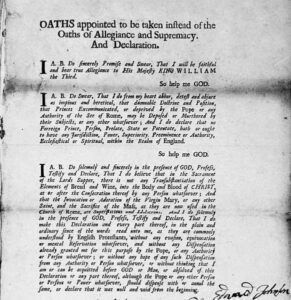
Oaths of allegiance and supremacy were required from individuals as a pledge of loyalty to the reigning monarch, who was recognised as the supreme head of the Church of England. These records are valuable for tracing individuals because they contain the names of public officials and clergy who took the oaths. They also name those who refused the oath and thus failed to conform to the doctrines and rules of the Church of England. An Oath of Allegiance was a pledge of loyalty to the sovereign and an Oath of Supremacy acknowledged the monarch as the head of the Church of England.
The principal Acts include:
- Act of Supremacy (1534): The first Act of Supremacy was established in 1534 under Henry VIII, which recognised the Monarch as the ‘Supreme Head of the Church of England’, rejecting the authority of the Pope. Public officials and clergy were required to swear an oath of allegiance.
- Act of Supremacy (1558): The Act replaced the original Act of Supremacy of 1534 which had been repealed during the reign of Mary I. The Act declared Elizabeth I the ‘supreme governor of the Church of England’. All clergy and public officials were required to swear an oath of allegiance, affirming loyalty to the Crown.
- Corporation Act (1661): Passed under Charles II, the act required all municipal officials must take the Holy Communion according to the rites of the Church of England. Those refusing to comply were removed from office. Office holders were required to take the Oaths of Allegiance and Supremacy.
- Test Act (1673): The Act, again passed under Charles II, extended religious restrictions to all civil and military offices. Officeholders were required to take oaths of allegiance and supremacy and receive Anglican communion within three months of taking office.
- Security of the Sovereign Act (1714): Passed under King George I, the act required all office holders, whether civil or military, peer or commoner, to appear before the King’s court and publicly swear an oath of allegiance to the Sovereign. It also required individuals, especially Catholics, to renounce allegiance to any pretenders to the throne.
These provisions effectively barred Roman Catholics and nonconformists and dissenters such as Congregationalists, Presbyterians, and Baptists from gaining official positions. Along with other acts, it formed part of the Clarendon Code, which were series of laws designed to suppress religious dissent. These Acts remained in force until their repeal in 1828, shortly before Catholic Emancipation in 1829.
Where Oaths Were Taken
London Residents who lived within thirty miles of London took the oaths in the Court of Chancery, Exchequer or King’s Bench. For those outside London oaths were taken at local Quarter Sessions. Those taking the oath also had to obtain a Sacrament Certificate which proved the person had received the Sacrament of the Lord’s Supper, in other words the Church of England communion.
Jacobite Rebellions
Following the Jacobite rebellion of 1715, the Papists Act of 1715 was passed which compelled all confirmed and suspected Catholic over the age of 18, including women, to swear an Oath of allegiance, supremacy and abjuration. Lists of those who signed before the Justices of the Peace or refused to take the oath can be found at county record offices amongst the quarter session records. A further Oath of Supremacy was added which caused severe problems for Roman Catholics as it required them to renounce the Pope as their religious leader. The discovery of a Jacobite conspiracy known as the Atterbury Plot, led to the passing of the Papists Act of 1722 which required all Roman Catholics to register and take an oath of allegiance to King George I, by 25 December 1723. Catholic landowners who refused to take these oaths were obligated to register their estates with the threat of forfeiture for non-compliance. These oaths of allegiance, supremacy and abjuration represented the last nationwide swearing of loyalty to the Crown. A finding aid list, compiled by Edward Vallance aims to identify all surviving returns of the 1723 oaths in England. It lists surviving returns county-by-county as well as background information on the various oaths of allegiance.
Catholics and Estate Seizures
Catholics refusing to take the oaths of loyalty faced serious repercussions. They were required to register their names and estates at the Quarter Sessions or risk having their property seized. The Forfeited Estates Commission was responsible for overseeing the seizure of the estates from Catholics who refused to comply. Details of seized estates were recorded in the Close Rolls held at The National Archives. The rolls contain detailed information about the legal proceedings and transfers of property related to oath refusals.
Easing of restrictions
The Sacramental Test Act of 1828, introduced by Lord John Russell, repealed the Corporation Act of 1661 and the Test Act of 1673. The regulations were loosened so that officials holding municipal, civil or military office only took an oath not to injure or weaken the Protestant church but crucially abolished the requirement to receive the sacrament. The reforms also removed any restriction on non-Anglican Protestants and Catholics holding public office. Under the Catholic Relief Act of 1778, Catholics could take a new Oath of Allegiance declaring their loyalty to the reigning sovereign. Taking this oath eased some of the restrictions imposed on Roman Catholics and allowed them certain rights such as the ability to own property and inherit land. Returns are recorded in series PC 1 held at The National Archives.
Other Oaths of Loyalty Containing Lists of Names
- Collection in Aid of Distressed Protestants in Ireland (1642): Charitable initiative which contains lists of individuals organised in support of Irish protestants subjected to widespread persecution. Surviving records in series SP 28 or E 179 held at The National Archives.
- Vow and Covenant (1643): This was an oath of loyalty to Parliament limited to members of the House of Commons taken in June 1643 during the English Civil War. The pledge of loyalty was in response to a royalist plot and aimed to support the fight against the royalists.
- Solemn League and Covenant (1643): The covenant raised during the English Civil War aimed to unite England, Scotland and Ireland under a presbyterian-parliamentary system. The oath was open to all subjects of these countries over the age of 18. Surviving material is held in series SP 28 or E 179 held at The National Archives.
- Free and Voluntary Present to the King (1661): Financial measure taken by the Parliament of England to raise funds for the restored King Charles II. The records of these voluntary contributions mainly from more wealthy individuals can be found in series E 179 at The National Archives or at County Record Offices.
Gibson’s Hearth Tax, Other Later Stuart Tax Lists and The Association Oath Rolls provides a comprehensive county-by-county breakdown of surviving tax lists, including their locations in various archives and repositories.
Conclusion
The Statute Law Revision Act of 1867 revised and repealed many outdated or unnecessary laws including some related to oaths. However, it did not abolish all old Oaths of Allegiance.
The final anti-Catholic declaration was only repealed in 1910 by the Accession Declaration Act. The declaration made by the sovereign upon accession affirmed their Protestant faith without denigrating Catholic beliefs. Finally, the Statute Law (Repeals) Act of 1969 formally removed many remnants of these historic oaths of allegiance and supremacy in British law. Specifically it repealed the Oath of Supremacy established by the Act of Supremacy in 1558.
Also see
Association Oath Rolls
Protestation Oath Returns
Returns of Papists’ Estates (Details of Roman Catholics who refused to sign)
Sacrament Certificates (Oath of Allegiance)
Where Found
- Series C 193/9, Chancery entry book of officers sworn by the Clerk of the Crown, 1639-1703.
- Series C 184, Chancery Oath Rolls and Entry Books, 1701-1985.
- Series C 214, Chancery Oaths of Allegiance and Test Oaths, 1673-1889. A large proportion of this series consists of rolls of oaths of allegiance and test oaths. There are also a number of solicitors’ oath rolls.
- Series C 215, Chancery Enrolments of Oaths, 1660-1713. Names of people who, at various times between 1673 and 1713, took the oaths of allegiance and supremacy, the test oath, and the oaths of association and abjuration in Chancery.
- Series CP 10, Court of Common Pleas: Attorneys’ Oath Rolls, 1789-1847.
- Series KB 24, Court of King’s Bench Oath Rolls and Files, 25 Charles II-1987.
- Series KB 113, Court of King’s Bench Attorneys’ Oath Rolls, 1750-1874.
- Series E 169, Exchequer Oath Rolls, 1709-1868The records in this series consist of oath rolls, mainly on parchment, of which there are three main types: oaths of allegiance, supremacy and abjuration; declarations against transubstantiation; and Papists’ oaths.
- Series E 200, Exchequer Solicitors’ Oath Rolls, 1730-1841.
- Series E 3, Exchequer of Pleas Attorneys’ Oath Rolls, 1830-1872.
- Series CHES 36, Palatinate of Chester Oath Rolls, 1697-1830.
- Series DURH 3/217, Palatinate of Durham Roll of oaths of allegiance and conformity, 1730-1837.
- Series CP 37, Court of Common Pleas Rolls of Oaths of Allegiance. Taken by Roman Catholics from 1778 and of Clergymen taking office.
County Record Offices
Quarter Sessions records which often include Oaths of Allegiance and Supremacy and sacrament certificates as well as Association Oath Rolls and Protestation Returns.
The London Archives
City of London Rolls held in the City Of London Sessions records including lists of papists. Other lists of oath takers and papists are also available at the archives covering various London districts.
Period Covered
1606 – 1828
Genealogical Value
- Name of person taking the oath
- Date oath taken
- Age of signatory
- Parish place of residence
- Occupation (Occasionally)
Further References
- Bevan, Amanda. Tracing Your Ancestors in The National Archives: The National Archives, 2006
- Gibson, Jeremy. Hearth Tax, Other Later Stuart Tax Lists and The Association Oath Rolls: Federation of Family History Societies, 1996
- Gibson, Jeremy & Dell, Alan. Protestation Returns 1641-42 and Other Contemporary Listings: Family History Partnership, 2004
- Gibson, Jeremy (ed). Politics and Loyalty in Post-Revolution Oxfordshire: The ‘1690’ County Parliamentary Poll: The Association Oath Rolls, 1695-6: Family History Partnership, 2011
- Vallance, E. Revolutionary England and the National Covenant: State Oaths, Protestantism and the Political Nation 1553-1682: Woodbridge, 2005
Websites
The National Archives Research Guide
How to look for records of Oaths of loyalty to the Crown and Church of England. This is a guide to records relating to oaths of loyalty to the Crown and Church of England in the seventeenth and eighteenth centuries.
University of Roehampton
The 1723 oath rolls in England: an electronic finding list, compiled by Edward Vallance. The aim of the project has been to attempt to identify all the surviving returns of the 1723 oaths in England. The finding aid lists surviving returns county-by-county as well as background information on the various oaths of allegiance.
Friends of Devon Archives
Devon and Exeter Oath Rolls, 1723. The site explores the historical context and significance of the 1723 Oaths of Allegiance in Devon. The resource provides detailed information about the oaths, legal requirements and the administration involved in the process.
Catholic Encyclopedia
English Post-Reformation Oaths
Who Do You Think You Are? Magazine
Finding Georgian Ancestors and Tracing Ancestors Using Oaths of Allegiance, by Edward Vallance.
Tudor Treasures & Medieval Musings
Tudor Oaths And Acts Of Supremacy And Succession, by Jessica Carey-Bunning.
Online Databases
Centre for Hearth Tax Research
This digital resource offers transcriptions of the 1723 oath returns held by the City of London Corporation and The London Archives. The transcriptions and document images were made by Dr Alex Craven. The 1723 oaths represent the last exercise in mass-public oath taking in England, prompted by the uncovering of a Jacobite conspiracy. The web site is run and maintained by the Austrian Centre for Digital Humanities (University of Graz, Austria) and Centre for Hearth Tax Research (University of Roehampton).
Ancestry
West Yorkshire, Roman Catholic Oath Records, 1714-1787, 1829. This collection contains lists and certificates of Roman Catholics failing to take the oaths of abjuration, allegiance and supremacy which were a part of an act passed by parliament in 1715.
Findmypast
Ireland, Catholic qualification and convert rolls 1701-1845. Explore over 50,000 records of Irish Catholics who swore loyalty to the crown or converted to Protestantism.
Findmypast
Protestation Returns, 1641-1642. Discover your early English ancestor on the Protestation Returns of 1641-1642. Learn if your ancestor took the oath of allegiance to the Protestant religion as well as where your ancestor lived.
Findmypast
Devon, Plymouth Borough Records 1519-1905. Various records from the borough’s administration including Oaths of allegiance.
Bath Ancestors
Bath Loyal Association Petition, 1792-1793. Search volume lists of those who signed this petition of loyalty to the King following fears that the French revolution would spread to England.
Friends of Devon Archives
Devon and Exeter Oath Rolls, 1723. Search the names of over 25,000 Devonians, amounting to some one in five of the adult population of the time. The database lists the men and women of the county who signed the oath before the Justices of the Peace in order to swear their loyalty to King George I.
CD Roms
N/A
