
Nature of Source
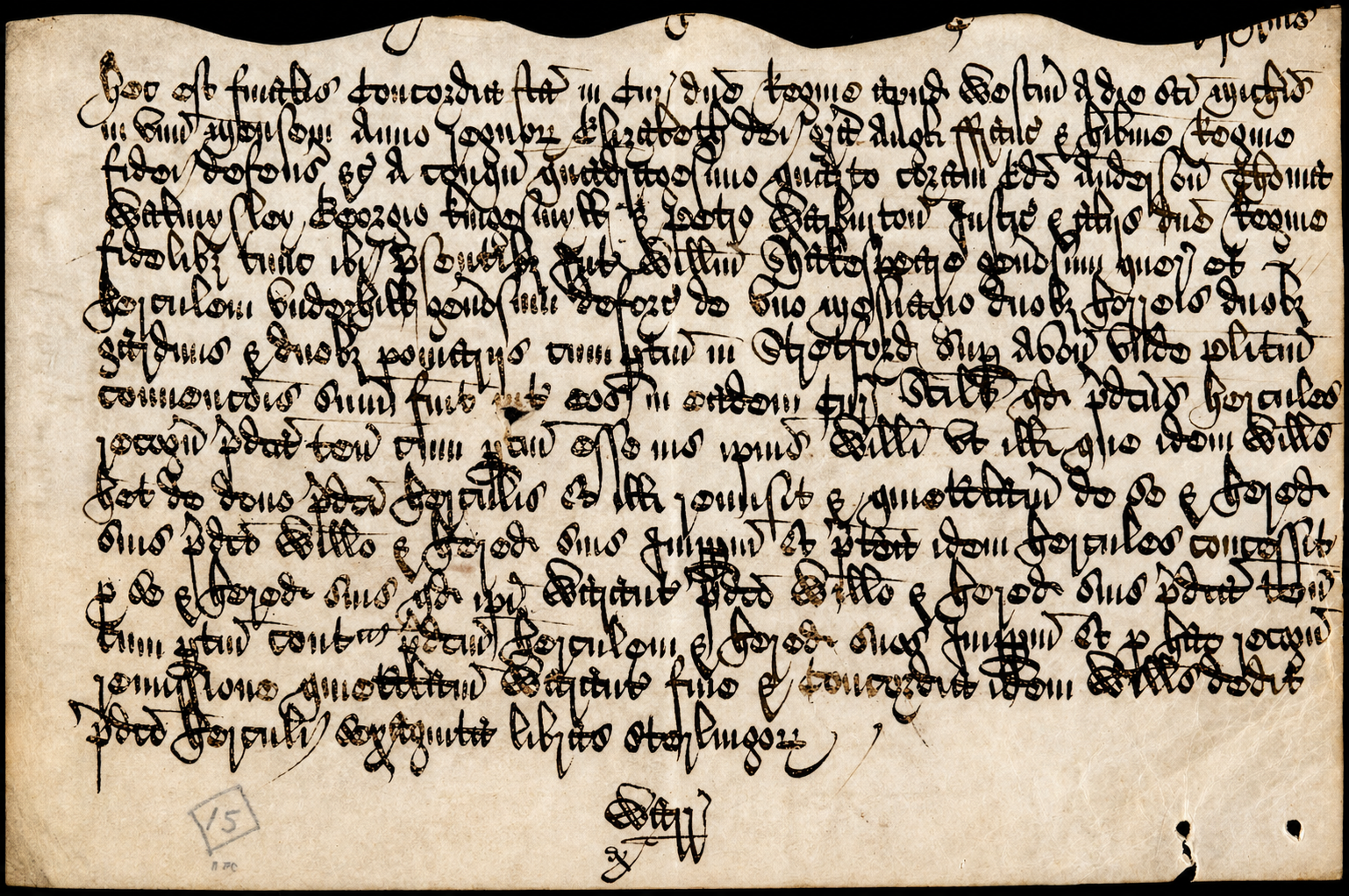
Warwickshire: Feet of fines for 44/45 Eliz I Mich
Shakespeare purchases New Place: 1602 foot of fine
Introduction
Feet of Fines and Common Recoveries were both legal fictions used in English law to facilitate the transfer of land and property and to break certain restrictions on property ownership such as entails and other settlements. Both procedures were primarily handled by the Court of Common Pleas which dealt with property disputes and legal actions, including those related to fee tails. However, both procedures served different legal purposes and involved distinct processes.
What Are Feet of Fines?
Feet of Fines were historic legal documents that recorded the final agreement or judgment in a fictitious lawsuit concerning the ownership or transfer of freehold land and property. These agreements offer an insight into an ancestor’s landholding and inheritance, particularly before the creation of official land registries. The lawsuit and the resulting A fine (or final concord) was a method used primarily to establish and record land title and ownership from the 12th century to the early 19th century.
Purpose and Process
The suit centred around a fictitious legal case. The purchaser or ‘plaintiff’ brought a claim of rightful ownership against the ‘deforciant’ (the vendor and person in possession) who was claimed to be preventing the rightful owner from occupying the property. In reality, both parties had already agreed to the transaction. The resulting settlement or final agreement was accepted by the court and became legally binding and served to:
- Provide proof of legal freehold ownership at a time when no formal land registry existed.
- Protect new owners from old claims.
- Prevent future claims from third parties within the notoriously complicated mediaeval system of property ownership.
- Sometimes circumvent entails (legal restrictions preventing property from being sold outside the family).
The final agreement or concord was written on one single membrane of vellum and divided into three parts:
- One for the buyer (plaintiff or querent).
- One for the seller (deforciant).
- One retained by the court called the ‘foot’ of the fine.
The suit was filed on close rolls at the Court of Common Pleas and occasionally involved the Court of King’s Bench and the Court of Chancery. The records were written in Latin until 1733, after which English was used. Do not confuse Feet of Fines with Fine Rolls, which were records of payments made to the king for various privileges and not directly related to property ownership.
Feet of Fines and Family History
The records are useful for:
- Tracing land transfers between individuals or families.
- Tracking property when passed to persons outside the immediate family possibly to distant relatives, in-laws or unrelated parties.
- Confirming ownership of land and property with details of the buyer and seller.
- Understanding inheritance practices. Feet of Fines were used to convey property rather than by direct sale, particularly when property passed outside the immediate family and direct descendants.
- Investigating efforts to bar entails (entailments or fee tails) that restricted inheritance to direct descendants.
- Disputes or changes in land ownership.
- Property settlements related to marriage, death or family separation.
- Dissolution of entailed estates to allow sale or inheritance by other parties.
Common Recoveries
A Common Recovery was a legal mechanism specifically about breaking fee tails (entails) to convert property into a fee simple estate. The process took place in the Court of Common Pleas and involved a staged lawsuit with the tenant in tail (the landowner) colluding with a purchaser (the plaintiff), claiming the plaintiff had a superior title to the land. A ‘common vouchee’ (usually a court official) was called on to defend the title but would default or fail to attend. The landowner would also default, conceding the case. A successful outcome was a court judgment declaring the plaintiff the rightful owner in fee simple, effectively removing the entail which meant land could be freely transferred or sold or inherited without limitations or restrictions.
Common Recoveries and Family History
The records are useful for:
- Tracing land transfers across families and generations. Recoveries document complex transactions often involving multiple parties.
- Tracking property outside immediate family, showing transfers to non-heirs.
- Confirming ownership and who gained control of land after an entail was broken.
- Investigating efforts to bar entails and the dissolution of entailed estates
- Investigating disputes or changes in ownership.
- Property settlements. Recoveries were used in marriage settlements, inheritance disputes and post-death arrangements.
Entails and Land Records
An entail, also known as a fee tail, was a legal mechanism in English common law designed to ensure that landed estates remained within a specific family line, passing automatically to direct descendants as determined by a settlement deed. The arrangement restricted the sale, transfer or disposal of the estate by the current owner which prevented the property from being transferred or conveyed outside the direct descendants. Entails were commonly established by deeds or settlements, often as part of marriage agreements.
Other Resources
Feet of Fines and Common Recoveries might not necessarily state the exact nature of the property transaction such as a gift, sale or marriage settlement so these property records should not be seen in isolation but as part of a wider set of documents detailing land transfers. Therefore, these records should be used in conjunction with other freehold land tenure documents which may be found amongst estate papers or family archives. To build a complete overview of a person’s land and property ownership other research records should be consulted such as:
- Freehold land tenure documents
- Estate records
- Manorial records
- Wills and deeds
- Chancery court records
Abolition of Final Concords and Common Recoveries
Both Feet of Fines (final concords) and Common Recoveries were eventually abolished by the Fines and Recoveries Act of 1833, bringing an end to these medieval conveyancing methods. The Act simplified the legal process for conveying land with more straightforward methods, marking a significant restructuring of English property law.
Where Found
- Series CP 25/2, Court of Common Pleas: Feet of Fines Files, Henry VIII-Victoria, 1509-1839.
- Series CHES 31, Chester County Court and Court of Great Sessions of Chester: Final Concords and Recoveries Files.
- Series DURH 12, Palatinate of Durham: Court of Pleas: Feet of Fines Files, 1535-1834.
- Series PL 17, Palatinate of Lancaster: Court of Common Pleas: Fines Files, 1377-1834.
- Series CP 40, Court of Common Pleas: Plea Rolls, 1273-1874.
- Series CP 43, Court of Common Pleas: Recovery Rolls, 1583.1837.
County Record Offices
Local archives will hold the feet of fines and common recovery records relevant to its area. Some Fines may be found in collections of estate papers, manorial records or private family papers. They may also have finding aids or indexes. Common Recovery ay be found in Quarter Session records.
National Library of Wales
The Library holds Feet of Fines for Wales, primarily from the medieval period through to their abolition in 1833. Common Recovery records can be found in the records of the Court of Common Pleas or Court of Great Sessions.
Local Record and History Societies
Published volumes of calendars.
Period Covered
1182 – 1834
Genealogical Value
- Names of individuals involved including the name of vendor and buyer.
- Family relationships including the name parents, children and sometimes the spouses of children.
- Wives’ names and marital status.
- Location or address and description of land and property under offer.
Further References
- Alcock, Nathaniel Warren. Old Title Deeds: Phillimore, 2001
- Chambers, Paul. Medieval Genealogy: Sutton, 2005
- Noble, Malcolm. A Practical Introduction to Medieval Genealogy: Bookcabin, 2026
- Westcott, Brooke. Making Sense Of Latin Documents For Family And Local Historians: Family History Partnership, 2014
Websites
The National Archives Research Guide
How to look for records of Land and property ownership: conveyances by feet of fines 1182-1833. Use this guide for advice on how to find ‘feet of fines’, documents held at The National Archives that record details of land and property changing hands between 1195 and 1833.
The National Archives Research Guide
How to look for records of Land and property ownership: enrolment and registration of title 1227-c1930. Use this guide if you are looking for details of who owned land and property in England and Wales, or for details of changes in the ownership of land, from the 13th century up until around 1930.
Medieval Genealogy
Abstracts of Feet of Fines: Introduction. The page introduces a project aimed at providing abstracts (summaries) of medieval feet of fines and explains the historical background of these documents.
Medieval Genealogy
Abstracts of Feet of Fines: Format of the records, 1360-1509. The webpage aims to explain the structure and typical content of late-medieval feet of fines records and provide practical help in interpreting the abstracts of these records.
Medieval Genealogy
A Short Introduction to Feet of Fines, by Chris Phillips.
University of Nottingham
Manuscripts and Special Collections. Research Guidance: Final Concord. The webpage explains the historical legal document known as a final concord, its purpose in property transactions, how to identify and interpret it. It offers practical advice and examples for anyone studying or working with historical English property deeds.
University of Nottingham
Manuscripts and Special Collections. Research Guidance: Common Recovery. The site offers a guide explaining the historical legal process known as Common Recovery. It offers a general overview with specific examples.
FamilySearch Digital Library
The site hosts a vast collection of digitized genealogy books and other material including A calendar to the feet of fines for London & Middlesex as well as calendars of feet of fines covering other counties.
The History of England
Glossary Of Medieval Terms
Foundation for Medieval Genealogy
The Foundation was established in 2001 by a group of British genealogists and historians with a special interest in the medieval period. The Foundation promotes the study of medieval genealogy and prosopography focusing on the period before 1500 AD. The FMG publishes a journal titled Foundations, which includes articles and reviews related to medieval genealogy. FMG has established a specialised collection of books, journals and offprints relating to medieval genealogy, heraldry and prosopography kept at the Centre for Medieval and Renaissance Studies in Oxford. The Library Catalogue provides a bibliographic catalogue of secondary source material for medieval genealogy and heraldry.
Ancestry Solutions
Land Records and Family History Research. The site is focused on the use of land records in family history and genealogical research.
Ancestry Solutions
Dictionary of terms found in Land Records.
Online Databases
MyHeritage
Lancashire Fines, 1196-1377. Lancashire Fines, edited by William Farrar and published in 1899 and 1903. These two volumes comprise transcripts in English of Feet of Fines – transfers of land and property.
The Genealogist
Published volumes of indexes include:
- Feet of Fines of the Tudor Period Part III 1583-1594
- Feet of Fines of the Tudor Period Part IV 1593-1603
- Huntingdon Calendar of the Feet of Fines 1194-1603
- London & Middlesex Fines, 1189 – 1485
- Yorkshire Feet of Fines, Vol II. Part I, 1486-1571
- Yorkshire Feet of Fines, Vol V. Part II, 1571-1583
- Yorkshire Feet of Fines 1327-1347
- Yorkshire Feet of Fines 1347-1377
- Yorkshire Feet of Fines 1486-1571
- Yorkshire Feet of Fines 1594-1603
- Yorkshire Feet of Fines 1603-1614
British History Online
An Abstract of Feet of Fines For the County of Sussex: Vol. 1, 1190-1248, edited by L F Salzmann. The first of three volumes of final concords for Sussex. It is re-published by kind permission of the Sussex Archaeological Society.
British History Online
An Abstract of Feet of Fines For the County of Sussex: Vol. 2, 1249-1307, edited by L F Salzmann. Further final concords for Sussex. The volume originally appeared as vol. 7 in the series of the Sussex Record Society. It appears here by kind permission of the Sussex Archaeological Society.
British History Online
An Abstract of Feet of Fines For the County of Sussex: Vol. 3, 1308-1509, edited by L F Salzmann. Final concords for Sussex for the fourteenth and fifteenth centuries. Originally published as volume 23 of the Sussex Record Society series; republished here by kind permission of the Sussex Archaeological Society.
British History Online
A Calendar To the Feet of Fines For London and Middlesex: Volume 1, Richard I – Richard III. Feet of fines for the period 1189 to 1485.
Ancestry
A Calender to the Feet of Fines for London & Middlesex, Richard I- Elizabeth I.
Medieval Genealogy
Abstracts of Feet of Fines. The aim of this project is to provide abstracts of the medieval feet of fines that have not yet been published initially for the period 1360-1509. The county list gives details of the feet of fines that have been published for each county.
Findmypast
Surrey Feet Of Fines 1558-1760. Search transcribed of over 20,000 feet of fines from the holdings at The National Archives in series CP 25/2, compiled by Cliff Webb.
Prosopography of Anglo-Saxon England
The database aims to provide structured information relating to all the recorded inhabitants of England from the late sixth to the late eleventh century. It is based on a systematic examination of the available written sources for the period. Sources include chronicles, saints’ lives, charters, inscriptions and coins.
SoG Data Online
Society of Genealogists. Worcestershire feet of fines 1649-1714. Transcript of the feet of fines for Worcestershire, edited by John Amphlett.
Internet Archive
The site hosts published volumes across many English counties such as:
- Yorkshire: Several volumes, such as those covering the years 1272-1300 and 1327-1347.cord Series.
- Dorset: Full abstracts of the feet of fines relating to the county of Dorset.
- Essex: Feet of fines for Essex.
University of Sheffield
Lands of the Normans in England, 1204-1244. The digital research project examines the 13th-century Anglo-French aristocracy between 1204 and 1244. It provides an interactive database of nearly 3,000 individuals and places, using historical records to map the redistribution of estates following the French annexation of Normandy. The project built the database using 2,000 individual documents collected from over 100 historical sources such as Charter Rolls, Patent Rolls, Feet of Fines, Cartularies, Chronicles and other primary sources.
Anglo-American Legal Tradition
Explore digital images of documents from Medieval and Early Modern England from The National Archives, 1200 to 1650. Series covered include:
- Series CP 40 (Court of common pleas plea rolls)
- Series KB 27 (Court of king’s bench plea rolls)
- Series E 159 and E 368 (Memoranda rolls)
- Series E 13 (Exchequer plea rolls)
- Series C 33 (Chancery orders and decrees)
- Series JUST 1, (Records of the General Eyre and commissions of assize)
- Series CP 25 (Feet of Fines)
