
Nature of Source
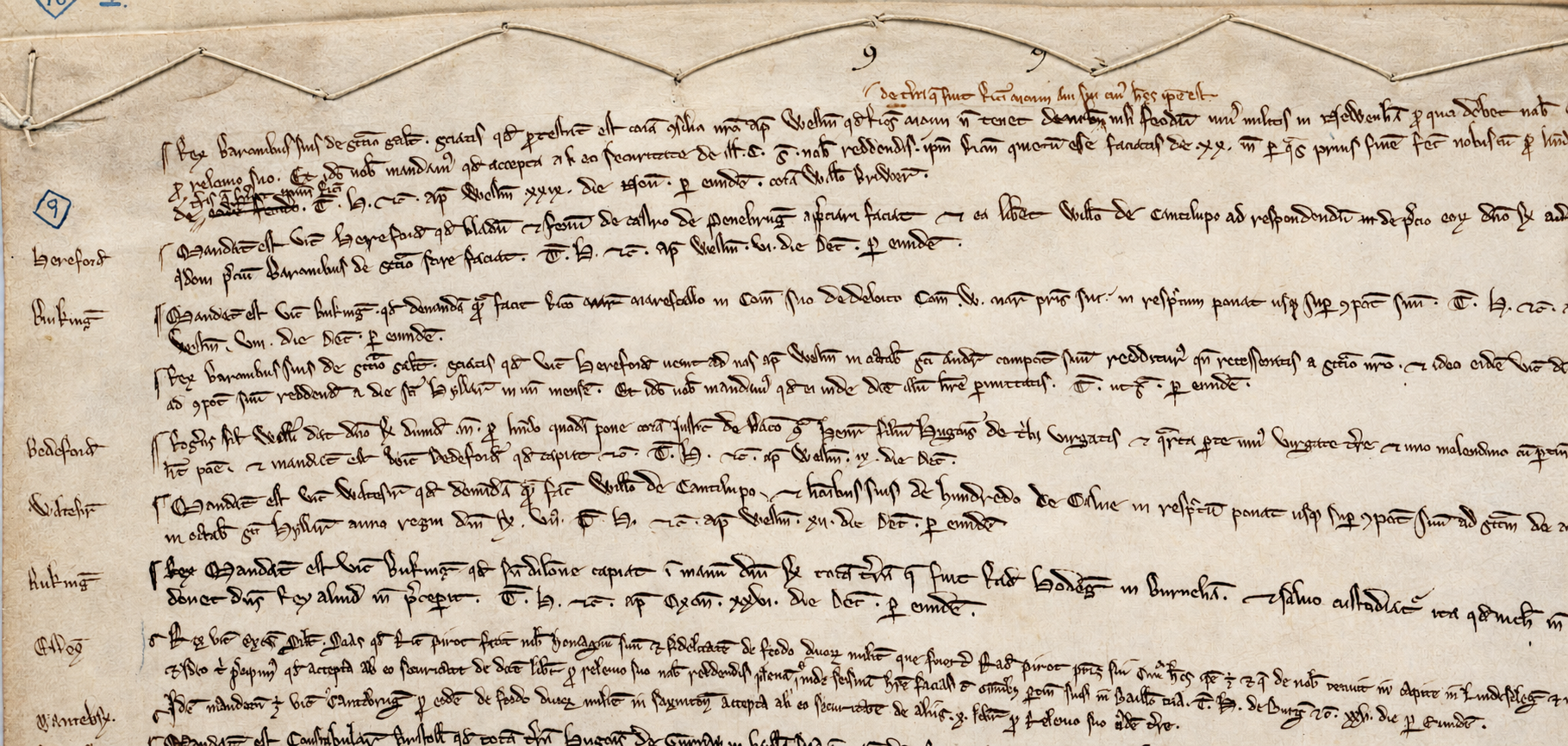
C 60/18, 7 Henry III, 1223
The National Archives and King’s College London
Introduction
Fine Rolls record offers of monetary payments or goods in kind (known as ‘fines’ or ‘oblata’) made to the Crown in return for royal favour, grants, licences, pardons, royal orders or the issuing of writs. In this context, a “fine” was not a penalty but a specific agreement to pay the Crown in return for a grant, licence or concession.
Development of Fine Rolls
The rolls, sometimes referred to as Oblata Rolls in the early years, survive from the reign of King John in 1199. They are particularly associated with Henry III (1216–1272) as a distinct central Chancery series. They continue with some changes in form, into the early modern period (principally to the 17th century). The rolls are of particular importance for the medieval period, forming a central record of day-to-day royal business conducted through Chancery.
What Do Fine Rolls Record?
The rolls primarily record the offer made to the Crown and the king’s (or chancellor’s) initial response. Typical entries include:
- Grants of land and recognition of tenure or property rights
- Livery of lands (to take possession of an inheritance estate)
- Licence to alienate (sell or transfer land)
- Custody/wardship of heirs and lands
- Permission to enclose land
- Confirmation of charters or liberties already claimed
- Licence to marry (especially where land or wardship was involved)
- Pardons for offences and release from imprisonment
- Settlement of debts owed to the Crown
- Rights to hold markets and fairs
- Grants of tolls, customs and trading rights
- The issuing of writs and royal orders
- Appointment of an escheator to oversee an Inquisition Post Mortem.
Fine Roll records are most useful for the study or research of landed families and tenants-in-chief or individuals involved in legal or feudal processes and those appearing in connection with royal grants or licences.
Relationship to Inquisitions Post Mortem
Fine Rolls frequently record the issuing of a writ to an Escheator to hold an Inquisition Post Mortem following the death of a tenant-in-chief in order to establish the lands held and the rightful heirs. They may also record payments made for livery of lands by the heir. However, the rolls do not contain the detail findings of the Inquisition Post Mortem, which are recorded as a separate series of records in the IPM series.
Where to Find the Outcome
The Fine Rolls record the offer made to the Crown and the terms upon which a grant might be obtained. The offer is enrolled on the Fine Roll which the Crown may accept it and proceed to payment which may then be made in full or in instalments or reduced or cancelled.
They record the offer and the Crown’s response but not always the final payment or completed agreement. To establish what actually happened, other record series need to be looked at alongside the Fine Rolls
For the final grant or decision itself:
- Patent Rolls: Public grants, offices, licences and pardons
- Charter Rolls: Formal grants of land or liberties
- Close Rolls: Private writs and administrative orders
For evidence of payment:
- Pipe Rolls: The Exchequer’s annual accounts. These accounts show whether the sum offered was actually paid, record debts, instalments, arrears or discharge.
For land and inheritance records:
- Inquisitions Post Mortem: These confirm succession and landholding. The Rolls should include a summary of the IPM.
- Records of livery of seisin: These show whether the heir took possession.
For later disputes:
- Court records and local manorial or estate records. These will show the nature of disputes and whether rights were exercised or whether land changed hands.
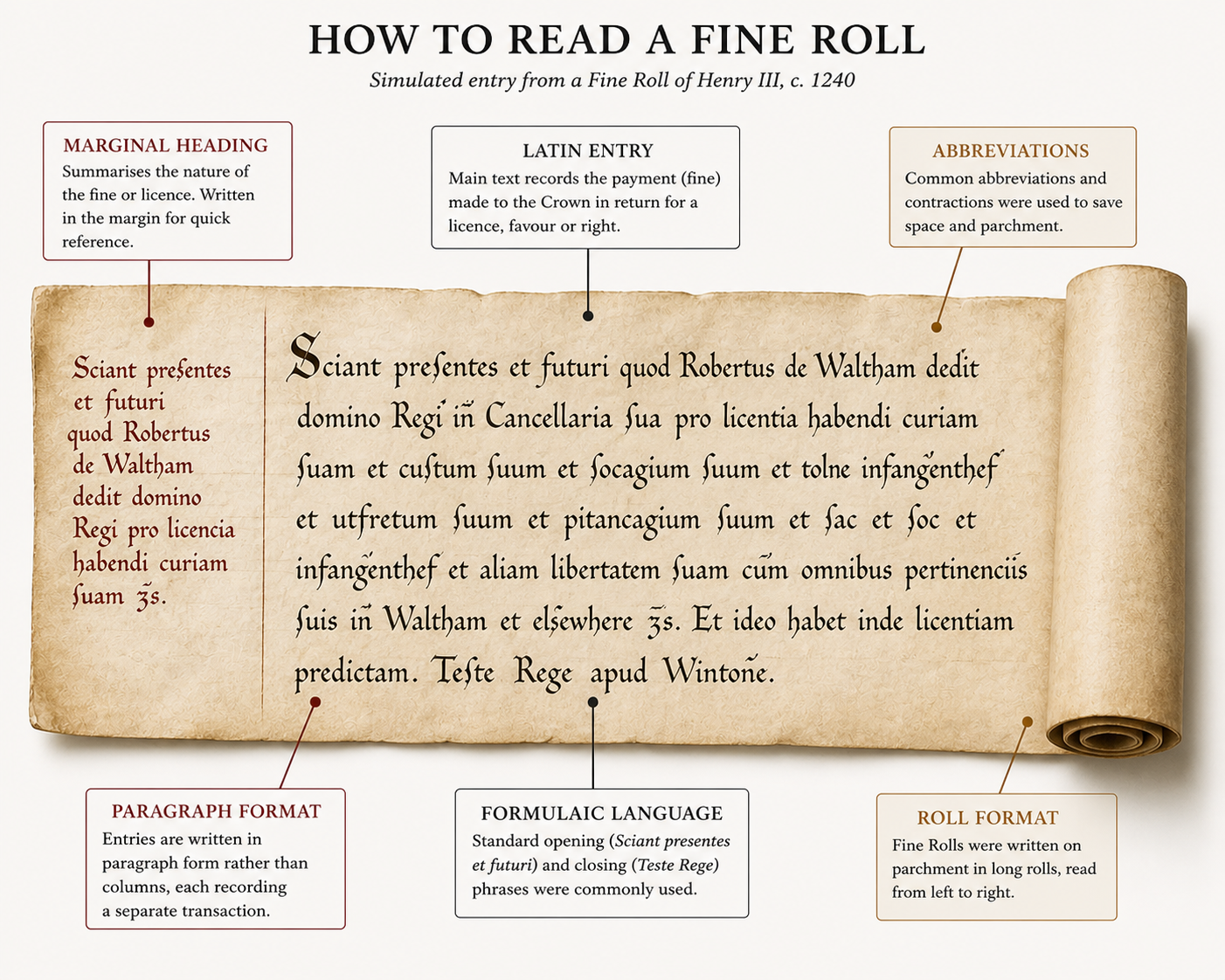
Entries are typically written in paragraph form in brief formulaic and technical language and often in Latin. This makes them particularly difficult to interpret. Published calendars and translations are therefore invaluable for making the records more accessible.
Additional Resources
The following GenGuide sources could assist in researching Fine Roll records:
Where Found
- Series C 60, Chancery: Fine Rolls, 1199-1648. A series of rolls which were begun in order to record offerings made to the king or his justiciar for royal favour in such matters as the disposal of lands and offices, succession to fiefs and liberties, or simply to assuage the king’s anger.
Period Covered
1199 – 1648
Genealogical Value
- Names of individuals
- Details of landholding, tenure, and inheritance
- References to heirs and family relationships
- Indications of status, wealth, and local standing
- Place names associated with estates and holdings
Further References
- Carpenter, David & Dryburgh, Paul & Hartland, Beth. Calendar of the Fine Rolls of the Reign of Henry III, 1216-1248: Boydell & Brewer, 2008. (First ever translation of the Fine Rolls makes available documents of crucial importance for study of the period. An e-book version of this title is available to libraries through a number of trusted suppliers)
- Chambers, Paul. Medieval Genealogy: How to Find Your Medieval Ancestors: The History Press, 2005
- Garrett, R.E.F. Chancery and Other Legal Proceedings: Pinhorns, 1968
- Hardy, Thomas Duffus, Sir. (ed.). Close Rolls, Rotuli Litterarum Clausarum, 1204-1227, 2 vols: Record Commission, 1833
- Noble, Malcolm. A Practical Introduction to Medieval Genealogy: Bookcabin, 2026
- Calendar of the Fine Rolls preserved in the Public Record Office, 22 vols: H.M.S.O., 1911-1962 (Covers 1272-1509. Search The Bibliography of British and Irish History for further details of each volume)
Websites
King’s College London
The Henry III Fine Rolls Project. This initiative provides a comprehensive translation and digitisation of the Fine Rolls from 1216 to 1272, making them accessible in English. The project makes the rolls available in a summarised and translated form. The site also provides extensive indexes of people, places, and subjects related to the rolls, as well as high resolution images of the originals. The site features 85 essays commenting on the historical interest of the rolls and an Introduction to Rolls detailing the origins and development of the rolls.
Medieval Genealogy
The section offers a clear expert guide to Chancery rolls (Close, Patent, Fine, Charter Rolls) especially useful for family historians.
Medieval Genealogy
The page links directly to digitised rolls, calendars and projects, noting date coverage, series classes and access points. The includes links to digitised editions of Calendar of the Fine Rolls Preserved in the Public Record Office series.
Brepols Publishers
Bibliography of British and Irish History. The resource is regularly updated database of over 680,000 books, journal articles, essays, edited collections, theses, and reviews on British and Irish history from 55 BCE to the present day. Managed by the Institute of Historical Research and hosted by Brepols. It is highly useful for locating medieval primary source material and for printed calendars such as Chancery records and other medieval bodies like the Exchequer or General Eyres. Brepolis itself is a specialist online platform of academic databases focused on medieval and early modern European history and literature.
Foundation for Medieval Genealogy
The Foundation was established in 2001 by a group of British genealogists and historians with a special interest in the medieval period. The Foundation promotes the study of medieval genealogy and prosopography focusing on the period before 1500 AD. The FMG publishes a journal titled Foundations, which includes articles and reviews related to medieval genealogy. FMG has established a specialised collection of books, journals and offprints relating to medieval genealogy, heraldry and prosopography kept at the Centre for Medieval and Renaissance Studies in Oxford. The Library Catalogue provides a bibliographic catalogue of secondary source material for medieval genealogy and heraldry.
University of Michigan
The Middle English Compendium. The site contains three Middle English electronic resources: the Middle English Dictionary which is the world’s largest searchable database of Middle English lexicon and usage for the period 1100-1500; Bibliography of Middle English prose and verse; Corpus of Middle English Prose and Verse.
Explore Genealogy
Medieval Ages Legal Records And Genealogy, by Chris Nickson
The History of England
Glossary Of Medieval Terms.
Online Databases
British History Online
BHO provides fully searchable digitised calendars of the Close Rolls, Patent Rolls, and Fine Rolls. Some volumes require a subscription for full access. Access the records under: Browse Catalogue → Guides and Calendars → Select Close Rolls, Patent Rolls or Fine Rolls. BHO consists of a digital library of British historical sources developed by Institute of Historical Research and the History of Parliament Trust.
Prosopography of Anglo-Saxon England
The database aims to provide structured information relating to all the recorded inhabitants of England from the late sixth to the late eleventh century. It is based on a systematic examination of the available written sources for the period. Sources include chronicles, saints’ lives, charters, inscriptions and coins.
TannerRitchie Publishing
Medieval and Early Modern Sources Online. The MEMSO database contains a large repository of medieval and early modern documents such state papers, calendars, charters, rolls, chronicles, accounts and correspondence from the archives of Britain, Ireland and continental Europe covering c.1100-1800.
University of Sheffield
Lands of the Normans in England, 1204-1244. The digital research project examines the 13th-century Anglo-French aristocracy between 1204 and 1244. It provides an interactive database of nearly 3,000 individuals and places, using historical records to map the redistribution of estates following the French annexation of Normandy. The project built the database using 2,000 individual documents collected from over 100 historical sources such as Charter Rolls, Patent Rolls, Feet of Fines, Cartularies, Chronicles and other primary sources.
Anglo-American Legal Tradition
Explore digital images of documents from Medieval and Early Modern England from The National Archives, 1200 to 1650. Series covered include:
- Series CP 40 (Court of common pleas plea rolls)
- Series KB 27 (Court of king’s bench plea rolls)
- Series E 159 and E 368 (Memoranda rolls)
- Series E 13 (Exchequer plea rolls)
- Series C 33 (Chancery orders and decrees)
- Series JUST 1, (Records of the General Eyre and commissions of assize)
- Series CP 25 (Feet of Fines)
CD Roms
HathiTrust Digital Library
View or browse published calendars of Fine Rolls.
Internet Archive
View or browse published calendars of Fine Rolls.
