
Nature of Source
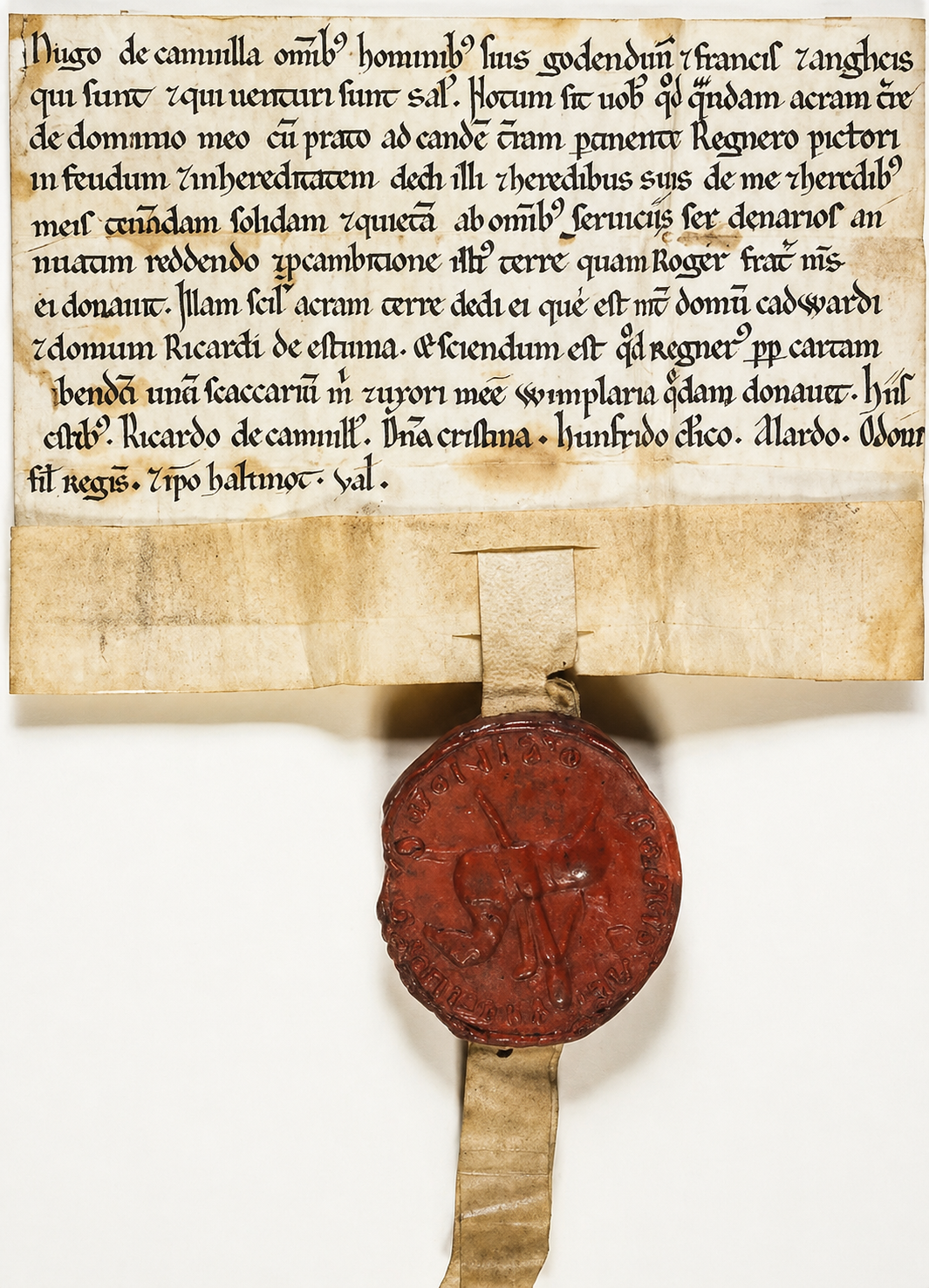
Magdalen College, Brackley B.186
Introduction
Charters are among the earliest surviving legal records in England and are particularly important for the study of landholding, rights and privileges in the medieval period. For family history research their usefulness is often limited to wealthier individuals, institutions and those involved in land transactions. They are particularly valuable for evidence of individuals connected with land, status and local administration. They could be issued by the Crown (royal charters) or by private individuals and institutions such as monasteries.
Royal Charters
Royal Charters were formally recorded on the Charter Rolls, which were maintained by the Court of Chancery. These rolls contain enrolments (official copies) of charters issued by the Crown and form an important series of administrative records. They were used as legal documents to record grants of rights, property and privileges issued by the Crown under the Great Seal, making them public records of the highest authority. They formed a central instrument of administration and landholding in medieval England. The Magna Carta sealed by King John of England at Runnymede in 1215 is widely regarded as the most famous example of a Royal Charter.
Royal charters granted a wide range of rights, including:
- Grants of lands, estates and conveyances and rights to lands.
- Liberties and privileges, such as the right to hold markets or fairs.
- Immunities and exemptions (e.g. from certain taxes or legal jurisdictions)
- Charters of incorporation for towns, cities, boroughs, universities, companies, and other bodies.
- Confirmation of earlier rights and grants
Some charters were also used to create honours or bestowing peerages, although in later periods such grants were more commonly made by Letters Patent.
The Charter Rolls cover the period from 1199 (reign of King John) to 1516. After this date, the separate series was discontinued and charters were instead enrolled on the Patent Rolls, where they appear alongside other Letters Patent.
Private and Institutional Charters
These were issued by members of the aristocracy, local lords and smaller landowners. They often record the transfer of land between individuals, acting as the legal deeds of their time. Institutions, particularly churches and monasteries, issued charters to lease out their lands or manage their property rights.
Cartularies
Many early charters, particularly those relating to land management, property rights and privileges, were copied into books known as Cartularies. These were manuscript books compiled primarily by monasteries and religious houses.
Cartularies typically contain copies of:
- Title deeds
- Grants of land
- Charters of privilege
- Confirmations of earlier rights
Although individual charters date back to the early Anglo-Saxon period, most surviving cartularies were compiled between the 11th and 14th centuries. They were created both as working document and as a means of safeguarding the institution’s property rights.
Additional Resources
The following GenGuide sources could assist in researching Charter Roll records:
Where Found
- Series C 53, Charter Rolls, 1199-1517. The enrolled charters on these rolls consist largely of charters of foundation and incorporation; grants of lands, liberties and privileges to cities, towns, civil and religious corporations, and individuals; creations of peerages; and grants of markets, fairs, free warrens, leets and hundreds.
British Library
The British Library has one of the largest collections of individual original charters and related rolls. These come mostly from private or institutional collections acquired over centuries and include deeds of grant, sale, lease, or confirmation between individuals, families or religious houses.
County Record Offices
Local archives primarily hold private charters, deeds and related rolls such as grants, sales, leases, settlements, or confirmations of land and property between individuals, families, monasteries or local institutions.
Bodleian Libraries, University of Oxford
The library has an extensive collection of charters and rolls, including over 1,600 items from Suffolk alone (many fully digitised). There is a published Calendar of Charters and Rolls Preserved in the Bodleian Library (1878, with supplements) and an online catalogue. Many date from the 12th–18th centuries and include private deeds and legal rolls.
Other University Libraries
University archives and special collections hold collections of individual charters, private deeds and related rolls.
Period Covered
1199 – 1517
Genealogical Value
- Names of landowners, tenants and neighbours
- Names of grantor, grantee, family members and witnesses
- Descriptions of lands and their boundaries
- Family relationships
- Details of the land or rights
- Social and economic status of ancestors
Further References
- Chambers, Paul. Medieval Genealogy: How to Find Your Medieval Ancestors: Sutton, 2005
- Davis, G.R.C. Medieval Cartularies of Great Britain: a Short Catalogue: Longmans, 1958 (Guide to published cartularies)
- Durie, Bruce. Documents for Genealogy & Local History: The History Press, 2013
- Hardy, Thomas Duffus, Sir. Rotuli Chartarum in Turri Londinensi Asservati, 1199-1216 [Charter rolls conserved in the Tower of London]: Record Commission, 1837 (Transcribed with indexes)
- Mullins, E. L. C. Texts and Calendars: An Analytical Guide To Serial Publications: Royal Historical Society, 1958 (Whereabouts of published material)
- Mullins, E. L. C. Texts and Calendars II: An Analytical Guide To Serial Publications 1957-1982: Royal Historical Society, 1983
- Noble, Malcolm. A Practical Introduction to Medieval Genealogy: Bookcabin, 2026
- Public Record Office. Calendar of the Charter Rolls Preserved in the Public Record Office, 1226-1516: Public Record Office, 1903 (Some volumes available to download at the Internet Archive)
- Stevenson, David & Stevenson, Wendy. Scottish Texts and Calendars: An Analytical Guide to Serial Publications: Scottish History Society, 1987 (Whereabouts of published material)
Websites
Medieval Genealogy
Charters. The section offers a concise guide to using charters for medieval English genealogy research focusing on private charters’ value, survival and challenges.
Medieval Genealogy
Medieval source material on the internet: Charters. The section offers hundreds of free online links to digitised charters, cartularies, catalogues and related texts.
The National Archives Research Guide
How to look for records of Royal grants in letters patent and charters from 1199. This guide will help you to find records of royal grants issued to individuals, public bodies or institutions since 1199 and now held at The National Archives. Royal grants cover a wide range of topics.
House of Commons Library
What is a Royal Charter? This short briefing explains what a Royal Charter is and how an organisation can become incorporated in this way.
Lancaster University
Medieval Primary Sources: Charters, Cartularies and Other Administrative Records. The guide provides detailed introductory notes on charter types, structure, historical significance, forgery risks, boundary clauses, and cartulary management.
Medieval Writings
Royal Charters.
National Library of Scotland
Scottish History Society: Scottish Texts and Calendars by David and Wendy Stevenson. The site hosts digitised volumes from the Scottish History Society that include extensive collections of medieval and later Scottish charters, bulls and related documents.
UCL Library Special Collections
English Monastic Archives: Monastic Database. The database s a comprehensive guide to pre-modern monastic records, including thousands of charters, cartularies and estate records from English religious houses. It catalogues charters locations, descriptions and provenance across UK repositories, helping in tracing land grants tied to families via monastic holdings
Brepols Publishers
Bibliography of British and Irish History. The resource is regularly updated database of over 680,000 books, journal articles, essays, edited collections, theses, and reviews on British and Irish history from 55 BCE to the present day. Managed by the Institute of Historical Research and hosted by Brepols. It is highly useful for locating medieval primary source material and for printed calendars such as Chancery records and other medieval bodies like the Exchequer or General Eyres. Brepolis itself is a specialist online platform of academic databases focused on medieval and early modern European history and literature.
The History of England
Glossary Of Medieval Terms.
Online Databases
Prosopography of Anglo-Saxon England
The database aims to provide structured information relating to all the recorded inhabitants of England from the late sixth to the late eleventh century. It is based on a systematic examination of the available written sources for the period. Sources include chronicles, saints’ lives, charters, inscriptions and coins.
The Electronic Sawyer
Online Catalogue of Anglo-Saxon Charters. The site presents in searchable and browsable form a revised, updated and expanded version of Peter Sawyer’s Anglo-Saxon Charters: an Annotated List and Bibliography, published by the Royal Historical Society in 1968. It was the first comprehensive listing of all surviving charters from the Anglo-Saxon period, containing over 1850 separate entries.
University of Sheffield
Lands of the Normans in England, 1204-1244. The digital research project examines the 13th-century Anglo-French aristocracy between 1204 and 1244. It provides an interactive database of nearly 3,000 individuals and places, using historical records to map the redistribution of estates following the French annexation of Normandy. The project built the database using 2,000 individual documents collected from over 100 historical sources such as Charter Rolls, Patent Rolls, Feet of Fines, Cartularies, Chronicles and other primary sources.
TannerRitchie Publishing
Medieval and Early Modern Sources Online. The MEMSO database contains a large repository of medieval and early modern documents such state papers, calendars, charters, rolls, chronicles, accounts and correspondence from the archives of Britain, Ireland and continental Europe covering c.1100-1800.
Anglo-American Legal Tradition
Explore digital images of documents from Medieval and Early Modern England from The National Archives, 1200 to 1650. Series covered include:
- Series CP 40 (Court of common pleas plea rolls)
- Series KB 27 (Court of king’s bench plea rolls)
- Series E 159 and E 368 (Memoranda rolls)
- Series E 13 (Exchequer plea rolls)
- Series C 33 (Chancery orders and decrees)
- Series JUST 1, (Records of the General Eyre and commissions of assize)
- Series CP 25 (Feet of Fines)
CD Roms
HathiTrust Digital Library
View or browse published calendars of Charter Rolls.
Internet Archive
View or browse published calendars of Charter Rolls.
