
Nature of Source
Introduction to Civil Registration
The introduction of civil registration of deaths in England and Wales followed the Births and Deaths Registration Act of 1836, which came into effect on 1 July 1837. From this date, all births, marriages and deaths were required to be reported to the register office in the district where the event took place. The original registration districts were usually based on the poor law union areas, each overseen by a Superintendent Registrar. Over time, the districts were adjusted to correspond with local authority administrative areas. Under this new system, couples could marry in a Church of England church, nonconformist places of worship, or the local register office. Jewish and Quaker marriage arrangements remained unchanged, as these groups were already licensed to conduct their own ceremonies?
Marriage in Anglican Churches
For a marriage in an Anglican church, it was not necessary for a registrar to be present as the vicar was licenced to conduct and register marriages. The vicar issued a marriage certificate to the married couple at the time of the ceremony. In addition, the church retained a register copy as well as sending quarterly returns a copy to the General Register Office in London. The banns system continued as before. The traditional banns system continued unchanged.
Nonconformist and Roman Catholic Marriages
For marriages at a nonconformist or Roman Catholic place of worship, it was necessary for a civil registrar to be present to enter the details into the marriage register. However in 1898 the rules were relaxed and all such places could apply for a licence to conduct their own ceremonies without the need for a registrar to be in attendance.
Civil Ceremonies in Register Offices
Under the new legislation, marriages could also take place as a civil ceremony in a register office supervised by a registry official. For marriages in a register office or a nonconformist chapel, a notice of intention to marry was displayed in the register office three weeks before the event and the marriage had to occur within three months. These marriage notices and any objections were recorded in ‘marriage notice books’ which can now be found at the local register office or in the local archives. Unfortunately many of the notice books have been destroyed and have not survived in great numbers. In addition, one of the parties had to reside in the registration district for at least a week before the issue of the marriage notice which meant that some couples only lived temporarily at the address listed on the certificate.
Understanding the National Indexes
National indexes were created from entries submitted quarterly to the General Register Office (GRO) in London. These indexed entries were copied from the registers held by local registry offices and others licenced to keep marriage registers. The copying process sometimes led to transcription errors and also be aware that civil registration certificates may contain inaccuracies or deliberate falsehoods. From 1911 onwards, the indexes only included the initial of a person’s middle name rather than the full name. Either the man’s surname or the woman’s maiden name can be searched in the indexes.
For a detailed explanation of the area and volume codes used in the indexes and their corresponding registration districts consult the GENUKI website. Note that Roman numerals were used for index reference codes from 1837 to 1851, while Arabic numerals and letters were used from 1852 to 1946.
Evolution of Index Formats
- 1837-1865: Handwritten indexes on vellum, often difficult to read.
- 1866 Onwards: Printed indexes introduced.
- 1984: Annual indexes replaced quarterly ones.
- 1984: Digital indexes replaced paper versions.
Indexes can be searched online at the GRO website and subsequently copies of certificates are available in a variety of formats including paper certificates, PDFs and instant images.
Marriage Ages and Restrictions
‘Full age’ as stated on a certificate meant the individual was 21 or over. Following the Marriage Act of 1753 (Lord Hardwicke’s Act), the legal age of marriage without parental consent (full age) was 21. Under canon law, the legal age of marriage for boys with parental consent was 14 and 12 for girls. In 1929, the minimum age for boys and girls was raised to 16 with parental consent required for those under 21. Unlike the many unregistered early birth records, most marriages were registered. Until 1907, the Church of England maintained strict rules about who could marry based on how closely they were related by blood (consanguinity) or by marriage (affinity) such as aunts and nephews, uncles and nieces and step-relatives. For a list of prohibited or forbidden marriages drawn up by the Church of England, see here and here.
Special Considerations
- If the bride was a widow, her first married name is listed in the marriage index unless she remarried under her maiden name by mistake.
- Illegitimate individuals might name a fictional father on their marriage certificate to avoid stigma.
- Unmarried mothers might give their father’s surname to an illegitimate child and later marry under their maiden name, complicating index searches.
Local and Online Resources
If an entry is missing from the national index, check with the local Register Office as they compiled their own indexes from their original records. Some of these registers have been deposited at the local archives and many are available online. The UK BMD website provides links to local transcriptions of UK births, marriages, deaths, parish registers and census returns. Users can also perform multi-region searches at UKBMD website.
Civil Registration in the Channel Islands and Isle of Man
Civil registration began in the Channel Islands in the 1840s. In the Isle of Man, births and deaths have been recorded since 1878 and marriages since 1884.
See Also
Civil Registration – Birth, Marriages & Deaths At Sea
Civil Registration, Birth
Civil Registration, Death
Consular and Overseas Records of Births/Baptisms, Marriages and Deaths/Burials
Divorce Records
Parish Registers-Marriages
Where Found
General Register Office for England and Wales
The General Register Office holds records covering England and Wales of births, deaths, marriages registered from July 1837 as well as civil partnerships, stillbirths and adoptions. Full Certificates of birth marriage and death are available to order. Historic birth and death indexes can be searched online at the GRO website
County Record Offices
The local archives hold historic registers for births, marriages and death for events registered at the local register office covering the county. Find the details of a local UK archive from a searchable list of over 2,500 archives hosted by The National Archives. Use the ‘Find an archive’ box to search for an archive.
Period Covered
1837 – Onwards
Genealogical Value
Index
- Full name.
- Surname of spouse from 1912.
- Registration District.
- Volume and Page.
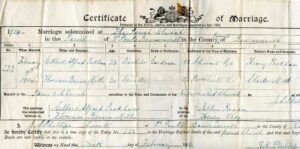
Certificate
- Date and place of marriage.
- Names of bride and groom.
- Ages, condition, occupation and addresses of each party.
- Both fathers’ names and occupation and stated if deceased.
- Witnesses names (Witnesses were often family members and should be further investigated especially in census returns).
Further References
- Annal, David. Using Birth, Marriage and Death Records: Public Record Office, 2002
- Annal, David & Collins, Audrey. Birth, Marriage and Death Records: A Guide for Family Historians: Pen & Sword Books, 2012
- Blayney, Molly Dolan. Wedded Bliss: Victorian Courtship and Marriage: Abbeville Press, 1992
- Chapman, Colin. Marriage Laws, Rites, Records and Customs: Was Your Ancestor Really Married?: Lochin Publishing, 1996
- Cohen, Deborah, Family Secrets: Living with Shame from the Victorians to the Present Day: Viking, 2013
- Foster, Michael Whitfield. A Comedy of Errors, or, The Marriage Records of England and Wales, 1837-1899: Mike Foster, 1998
- Foster, Michael Whitfield. A Comedy of Errors. Act 2: Mike Foster, 2002
- General Register Office, Abstract of Arrangements Respecting Registration of Births, Marriages and Deaths in the United Kingdom and other Countries of the British Commonwealth and in the Republic of Ireland: HMSO, 1952
- Gibson, Jeremy & Hampson, Elizabeth. Marriage, Census and Other Indexes for Family Historians. 5th ed: FFHS, 1994
- Gibson, Jeremy; Hampson, Elizabeth; Raymond, Stuart. Marriage Indexes for Family Historians. 9th rev. ed.: The Family History Partnership, 2007
- Higgs, Edward. Life, Death And Statistics: Civil Registration, Censuses And The Work Of The General Register Office, 1836-1952: Local Population Studies, 2004
- Langston, Brett. A Handbook to the Civil Registration Districts of England and Wales: Family History Partnership, 2003
- Lansdell, Avril. Wedding Fashions 1860-1980: Shire Publications, 1983
- Probert, Rebecca. Marriage Law for Genealogists: The Definitive Guide: Takeaway Publishing, 2012
- Probert, Rebecca. Divorced, Bigamist, Bereaved? The Family Historian’s Guide to Marital Breakdown, Separation, Widowhood, and Remarriage: from 1600 to the 1970s: Takeaway Publishing, 2015
- Raymond, Stuart. Births, Marriage & Deaths on the Web: Southern England, The Marches and Wales. Vol 1: Family History Partnership, 2005
- Raymond, Stuart. Births, Marriage & Deaths on the Web: Midlands, Northern England and East Anglia. Vol 2: Family History Partnership, 2005
- Wiggins, Ray. Registration Districts: An Alphabetical List of Over 650 Districts: Society of Genealogists, 2001
- Wood, Tom. An Introduction to British Civil Registration. 2nd ed: FFHS, 2001
Websites
GOV.UK
Research your family history using the General Register Office
GOV.UK
Events recorded in England, Wales and overseas
This is a list of the types of events that are recorded in England, Wales and overseas for which the General Register Office holds records. It also gives the dates for which the records are held.
General Register Office
Discover your family history
Booklet describing how the GRO can help you research your family tree and family history.
General Register Office
Guides to researching your family tree
GRO guides to birth certificates, marriage certificates and death certificates.
General Register Office
Guides to help you carry out your family history research
The National Archives Media
Early civil registration, by Audrey Collins
GENUKI
England Civil Registration
Links and information.
GENUKI
GRO Indexes Registration Districts.
The three following lists provide the reference numbers of the registration districts for births, marriages and deaths in England and Wales.
UKBMD
Registration Districts in England and Wales.
Listing county-by-county of civil registration districts in England since 1837 to the present and in Wales between 1837 and 1996. The entries show the areas covered by each district and the administrative changes overtime. The same districts were also used to compile the census for the years 1851 to 1911. The site also links to an alphabetical listing of all the registration districts.
UKBMD
Index of Places in England and Wales.
For each place listed, this index shows the county and registration district in which it was situated between 1837 and 1974, at which latter date the districts were considerably altered.
Society of Genealogists
How to search for Birth, Marriage and Death certificates
Society of Genealogists
How to search for Birth, Marriage and Death certificates
Locating your ancestor using civil registration
FreeBMD
Registration District Information.
Information about registration districts with a list of official districts.
FamilySearch
Historical Maps
Maps showing the administrative areas and units of England showing boundaries for the Civil Registration District, the Parish, the County, the Diocese and other administrative areas.
Ancestry Solutions
Civil Registration
Guide to content, commencement date, indexes and how to obtain civil birth, marriage and death certificates
Findmypast
A beginner’s guide to using birth, marriage and death records for family history
Often the key to growing your family tree, here’s everything you need to know about vital life event records.
Wishful Thinking
A Historical Account of the Development of Local Registration Offices in England and Wales, by Rosemary Lockie
Marriage Resources
Genealogy Stories
Marriage Records for Genealogy
This blog post is the guide to finding and using marriage records for genealogy purposes
FreeBMD
Finding the spouse
If you are trying to find the other partner in a marriage from index entries, particularly before 1912, this page may be of help to you.
Findmypast Blog
Here’s why there used to be so many Christmas Day weddings, by Alex Cox
Bridal Resources
A Brief History of the Wedding Dress in Britain
Article and illustrations by Elizabeth Davies
Online Databases
National GRO Coverage
FreeBMD
Search free to view transcribed civil registration indexes of births, marriages and deaths from 1837 for England and Wales. Free access to the records is also available via ancestry.co.uk covering the years only from 1837-1915. The project is a volunteer led with records added daily and part of the Free UK Genealogy organisation.
General Register Office for England and Wales
Search the GRO historic birth and death indexes and order certificates online. These are birth records from 1837 to 1934 and from 1984 to 2004 and death records from 1837 to 1957 and from 1984 to the current year. Please note that the age at death is shown on all the GRO online death indexes from 1837 onwards. Marriages have not yet been digitised. Customers must have a registered GRO online certificate ordering account to use the service. Access death certificate images instantly covering 1837 to 1957 and birth certificate images instantly covering 1837 to 1922 at a cost of £2.50 each.
Findmypast
England & Wales Marriages, 1837-2005. Search the General Register Office marriage indexes covering England and Wales. Each record comprises a transcript of the original register and are fully indexed by name. The MarriageFinder feature will match up your ancestors’ records providing you with one definite marriage match or a list of possible matches.
Ancestry
England & Wales, Civil Registration Marriage Index, 1837-1915. This database is a searchable and browsable digitized version of the indices of civil marriage registrations in England and Wales, reported quarterly to the General Register Office in London. This database is made available to Ancestry users courtesy of the volunteers of the FreeBMD organization.
Ancestry
England & Wales, Civil Registration Marriage Index, 1916-2005. This database is a searchable and browsable digitized version of the indices of civil marriage registrations in England and Wales, reported quarterly to the General Register Office in London. Images are only available through 1983.
MyHeritage
MyHeritage offers an index of civil birth registrations for England and Wales from 1837 to 2005; civil marriage registrations from 1837 to 2005; civil death registrations for England and Wales from 1837 to 2005.
The Genealogist
BMD Records 1837-2005: Complete Birth, Marriage & Death records index for England and Wales as published by the GRO. The indexes are searchable in database format from 1837-2005 for Marriages with the facility to match and cross-reference one name with another surname, 1837-2005 for Births and 1950-2005 for Deaths.
FamilySearch
England and Wales Marriage Registration Index, 1837-2005. Index to marriages registered in England and Wales beginning 1 July 1837 through 2005.
Ancestry
London, England, Marriage Notices from The Times, 1982-2004. Search around 80,000 wedding announcements extracted from engagement and marriage announcements published in London’s Times newspaper.
Findmypast
England, Newspaper Marriage Notices. Search over 700,000 marriage notices across England published in English newspapers. The index provides a link to the actual newspaper notice.
BMD Registers
BMD Registers. Records of birth, baptism, marriage, death and burial taken from non-parish sources including Overseas Records.
Local Coverage
UKBMD
The volunteer led site provides links to websites that offer on-line transcriptions of GRO and local births, marriages and deaths indexes as well as censuses returns. A wide range of other indexes and transcriptions are also available for most counties. These may include parish records, wills and monumental inscriptions. The site hosts the Online Parish Clerks project which contains transcribed parish registers and other parish records.
Gloucestershire BMD Indexes
The aim of the project is to index all the registers held by the Gloucestershire Registration Service. All births registered in the county between 1837 and at least 1912 have been indexed; All deaths registered in Gloucestershire between 1837 and at least 1900 have been indexed and all marriage registers stored by GRS at Gloucestershire Archives have been indexed. The indexing is carried out by volunteers from the Gloucestershire Family History Society in conjunction with the Gloucestershire Registration Service and Gloucestershire Archives.
Findmypast
Derbyshire Registrar’s Birth, Marriage and Death Index
Lancashire BMD
Online access to the birth, marriage and death indexes held by the local registration services developed in partnership with the county’s Family History Societies. See website for date coverage and registration districts covered.
CAMDEX
Index of Births, Marriages, Civil Partnerships and Deaths in Cambridgeshire since 1837 in association with the Cambridgeshire Family History Society and Cambridgeshire County Council. The index is available to review by members of the public free of charge: copies of BMD certificates can be ordered and paid for on-line from the CCC Registration Service.
Online Genealogical Index
The site locates and lists available free and paid for family history records covering a particular county, town or village covering England, Wales and the Isle of Man. The site is particularly useful for locating birth, baptism, marriage, death, burial and cemetery records as well as monumental inscriptions, school records, war memorials and family pedigrees.
Ancestry
Staffordshire, England, Birth, Marriage and Death Indexes, 1837-2017. This collection comprises indexes of civil registrations from Staffordshire local civil registrar offices, excluding the City of Stoke-on-Trent
Calderdale Council
Indexed birth, marriage and death notices for the entire period of the Halifax Guardian’s existence from December 1832 to April 1921
The Dorset Death Certificate Index
The site covers deaths registered in the county of Dorset from 1837 onwards. The certificates transcribed for this site have been made available by other family historians. The advanced search facility allows searching for occupations, places, causes of death, and for details of doctors, coroners and ‘informants’.
Cornwall OPC Database
Search birth, marriage and death certificate transcripts
Pickard’s Pink Pages for Warwickshire
Warwickshire newspaper extracts covering births, marriages and deaths.
Ancestry
Andrews Newspaper Index Cards, 1790-1976. The index which is kept by the Institute of Heraldic and Genealogical Studies features a collection of notices from newspapers and various official sources including announcements of births, marriages, obituaries, and deaths abroad; notices of wills, unclaimed estates and advertisements for missing persons and people seeking next of kin.
CD Roms
S & N Genealogy Supplies
Indexes to Overseas BMDs, 1916-1940.
Lancashire Family History and Heraldry Society
Andrew Todd’s map of Lancashire 1851 showing the Registration Districts of Births, Marriages & Deaths, Registration Sub-Districts, Parishes, Townships and all Anglican churches and dates of their earliest registers.
Kent Family History Society – Medway Branch
Index of Medway Marriages 1837-1938: The index is compiled from the original marriage registers held by Medway Register Office covering Church of England, non-conformist and register office marriages.
